Get the weekly SPARTANAT newsletter.
Your bonus: the free E-Book from SPARTANAT.


UKRAINE: 3 QUESTIONS - 3 ANSWERS, PART 8: Battle for the cities
In this interview, Major Klaus Kuss, an expert in close combat, answers questions about urban warfare in the context of the war in Ukraine.

Major Klaus Kuss is a close combat expert at the Army Troop School and Deputy Head of the Jaeger Institute. He is also an "International Urban Operation Advisor." Here he answers current questions about the war in Ukraine.
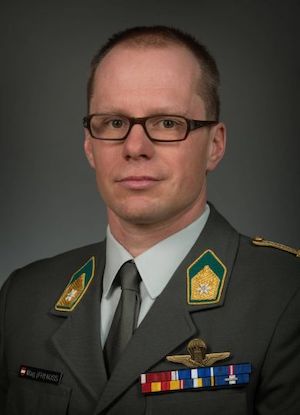
The Bundesheer expert says:
More and more Ukrainian cities are becoming the focus of the news. How should we imagine these battles in urban areas?
Fighting in an urban area is generally one of the most difficult and bloodiest types of combat. The battle is conducted on a three-dimensional battlefield. This means that you can be attacked not only from buildings but also from underground systems (e.g. the sewer system) or from rooftops. Threats can come from all directions, and you never know where the enemy is.
The combat distances are very short, often requiring close combat. A lot of firepower is concentrated in a very restricted area, and the effectiveness of weapons, such as artillery shells or rockets, is greatly enhanced by shrapnel and the dense urban construction.
Combat in the urban environment is therefore psychologically and physically very tough, exhausting, and also very costly in terms of casualties.
How should the civilian population of a city behave when it is under attack?
The civilian population should - as long as it is possible and maybe there are humanitarian corridors or similar options - try to leave the city. If leaving is no longer possible, it is advisable to seek shelter in cellars, the subway system, or in bunkers. Being outdoors should be strictly avoided, as there is a risk of getting caught between the warring parties or being injured or killed by the aforementioned weapon effects.
Under no circumstances should the civilian population actively participate in the combat. The people are not adequately armed, equipped, or trained for it and are therefore at a significant disadvantage compared to regular forces. Combatants do not have combatant status, do not fall under international humanitarian law, and are not protected in this respect.
Why is the occupation of cities so significant? Isn't it enough to control the surrounding area?
Cities fundamentally represent the political, economic, cultural, infrastructural, and religious centers of a country. They are therefore of great importance and have a very high symbolic value, as they often have a historically significant past.
The occupation by hostile forces has a strongly negative psychological and moral effect on the defending forces and people of a country. People are more willing to give up rural areas with little infrastructure than a city.
Another reason is that a large part of the population lives in urban areas, and an attacker wants to control these people and impose his will on them. The general trend of urbanization also puts cities in focus for strategic considerations.
BUNDESHEER online
UKRAINE: 3 Questions – 3 Answers
– UKRAINE: 3 FRAGEN – 3 ANTWORTEN, TEIL 7: LUFTKRIEG UND DROHNEN
– UKRAINE: 3 FRAGEN – 3 ANTWORTEN, TEIL 6: ATOMKRAFTWERKE UND NUKLEARE BEDROHUNG
– UKRAINE: 3 FRAGEN – 3 ANTWORTEN, TEIL 5: WELCHE WAFFEN?
– UKRAINE: 3 FRAGEN – 3 ANTWORTEN, TEIL 4: WAFFEN FÜR KIEW?
– UKRAINE: 3 FRAGEN – 3 ANTWORTEN, TEIL 3: GIBT ES WIDERSTAND?
– UKRAINE: 3 FRAGEN – 3 ANTWORTEN, TEIL 2: WELCHE FOLGEN HAT DER ANGRIFF?
SPARTANAT is the online magazine for Military News, Tactical Life, Gear & Reviews.
Send us your news: [email protected]
Ad
similar
Get the weekly SPARTANAT newsletter.
Your bonus: the free E-Book from SPARTANAT.
