Get the weekly SPARTANAT newsletter.
Your bonus: the free E-Book from SPARTANAT.


UKRAINE: 3 QUESTIONS - 3 ANSWERS, PART 15: Battle of the combined arms?
Oberst Markus Reisner discusses aspects of the war in Ukraine, including combined arms fighting, targeting senior Russian commanders, and the effectiveness of anti-tank weapons. The Bundesheer expert provides insights into military operations in the conflict.

Oberst Markus Reisner heads the development department at the Military Academy in Wiener Neustadt. Here he explains some aspects that often come up in questions about the war in Ukraine.
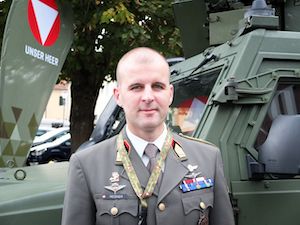
Statement from the Bundesheer Expert:
Military experts often talk about the "combined arms fighting" in the context of conventional warfare. What can be understood by that?
In the so-called "combined arms fighting," soldiers from all weapon branches work together using all their abilities - in all areas of warfare: on land, in the air, in water, in space, but also in the digital realm, on the internet, and in the information environment.
This cooperation starts with the troops in the field supporting each other, for example, when mechanized units on the ground receive air support from aircraft or helicopters. This continues to the highest level, such as satellite reconnaissance, targeted communication, or the use of strategic bombers and intercontinental missiles.
There are often reports in the media about killed Russian generals. Does the high death rate come from the senior officers leading "from the front" or are they victims of snipers?
The causes are different here. Thanks to the reconnaissance support by NATO, or by the USA in particular, it can be assumed that the Ukrainian armed forces are capable of repeatedly attacking the headquarters of senior Russian commanders (for example, with long-range artillery). This is documented in one case.
In addition, the Russian forces apparently suffer from communication problems. This leads to commanders moving their mobile command posts close to the frontlines. Here, with inadequate self-protection, they can become targets of snipers. This is also documented in at least one case.
In social media, many videos show heavy Russian tanks being exploded by relatively small and light weapons. How can this strong effect or penetrating power be explained?
Every tank has its weaknesses. The armor on the turret roof, sides, and rear is usually less pronounced. Additional reinforcement of the armor (such as attachments or so-called reactive armor) significantly increases the weight of the vehicle and limits mobility and therefore striking power.
Modern anti-tank systems also try to bypass the various defense measures, for example, by using tandem shaped charge rounds or by an "Top Attack Mode" attack from above on the turret. Either the reactive armors are overcome, or the weaknesses (the turret roof) are targeted.
There are defense systems that can detect an incoming projectile or tank missile and engage it while still in flight. However, these systems are usually available in small numbers.
BUNDESHEER online
UKRAINE: 3 Questions - 3 Answers
- UKRAINE: 3 QUESTIONS - 3 ANSWERS, PART 14: TANK BATTLE?
- UKRAINE: 3 QUESTIONS - 3 ANSWERS, PART 13: UNDERGROUND FIGHT?
- UKRAINE: 3 QUESTIONS - 3 ANSWERS, PART 12: CYBERWAR?
- UKRAINE: 3 QUESTIONS - 3 ANSWERS, PART 11: NEUTRALITY?
- UKRAINE: 3 QUESTIONS - 3 ANSWERS, PART 10: HOW'S IT GOING?
- UKRAINE: 3 QUESTIONS - 3 ANSWERS, PART 9: NBC THREAT?
- UKRAINE: 3 QUESTIONS - 3 ANSWERS, PART 8: URBAN COMBAT
- UKRAINE: 3 QUESTIONS - 3 ANSWERS, PART 7: AIR WAR AND DRONES
- UKRAINE: 3 QUESTIONS - 3 ANSWERS, PART 6: NUCLEAR POWER PLANTS AND NUCLEAR THREAT
- UKRAINE: 3 QUESTIONS - 3 ANSWERS, PART 5: WHAT WEAPONS?
- UKRAINE: 3 QUESTIONS - 3 ANSWERS, PART 4: WEAPONS FOR KYIV?
- UKRAINE: 3 QUESTIONS - 3 ANSWERS, PART 3: IS THERE RESISTANCE?
- UKRAINE: 3 QUESTIONS - 3 ANSWERS, PART 2: WHAT ARE THE CONSEQUENCES OF THE ATTACK?
- UKRAINE: 3 QUESTIONS - 3 ANSWERS, PART 1: WHAT'S GOING ON?
SPARTANAT is the online magazine for Military News, Tactical Life, Gear & Reviews.
Send us your news: [email protected]
Ad
similar
Get the weekly SPARTANAT newsletter.
Your bonus: the free E-Book from SPARTANAT.
