Get the weekly SPARTANAT newsletter.
Your bonus: the free E-Book from SPARTANAT.

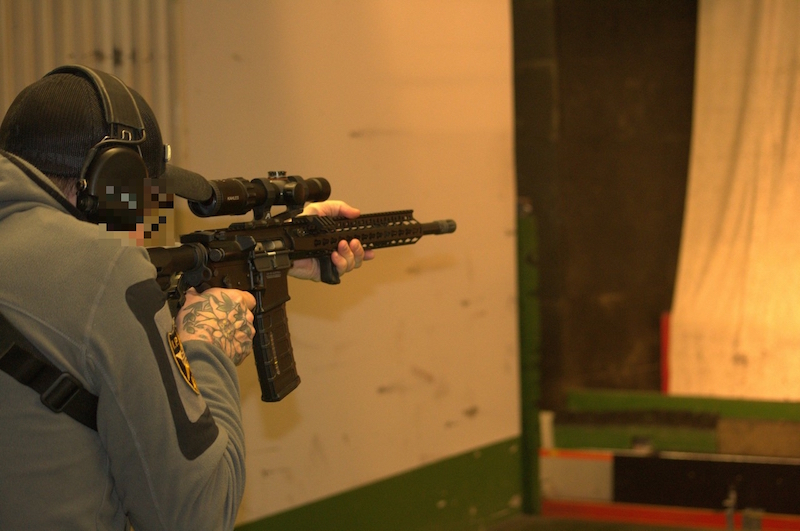
TRAINING WITH KL STRATEGIC (3): The natural holding point
The text discusses the concept of the natural stopping point in shooting, emphasizing the importance of body alignment and posture. It explains how to find and train the natural stopping point to improve shooting accuracy and maintain muscle memory. The text provides practical tips and techniques for shooters to enhance their skills and achieve consistent results.

Simple, yet for many a book with seven seals. This is how one can describe the natural stopping point. In simple terms, the use of the natural stopping point is nothing more than listening to your own body in connection with a firearm.
What is this natural stopping point, and what can it do for me?
This question will be answered with the following lines:
The natural stopping point is determined by the natural body tension and is therefore different for each person. In the end, it is the point to which the body naturally aligns the firearm and then perceives this posture as natural or, under the given conditions, maximally relaxed.
In the best case scenario, the target point and the natural stopping point align without additional muscle strain. For this, it is necessary that the body is correctly aligned relative to the target and in the appropriate posture. To be able to intuitively assume this posture and alignment, a lot of training and muscle memory is required, and once this is achieved, this state must be continuously trained. Unfortunately, the body is an evolving organism and changes, thus the natural stopping point must be adjusted repeatedly. This means: Training, training, training!
In order to find the natural stopping point, it is necessary to first assume the correct posture in each shooting stance - the one that requires the least additional muscle effort. Of course, the natural stopping point can also be found with a different state, however, the repeatability for continuous training is questioned. In addition, the natural stopping point also depends on external factors. Different firearms have a significant impact on this. This means that the natural stopping point must be determined for each firearm.
It is recommended to carry out this determination - if possible - briefly before each shooting session. The deviations are not so extreme, allowing for a basic posture to be trained and the fine details to be specifically determined.
As already outlined in the article on stance (Part 2 - Stance), the naturalness of movements and postures is crucial for stress-resistant firearm handling. Any unnecessary muscle contraction disrupts the process and weakens concentration, as one deals with "trivia".
This also applies to the natural stopping point. Once this has been found and assumed, it is possible to hit a target with closed eyes in a repeatable manner. This is because unnecessary and specially made muscle contractions do not need to be rebuilt after each shot, but the body does exactly what it always does. Therefore, the firearm theoretically always returns to the exact same stopping point - the natural stopping point!
However, there are some discrepancies between theory and practice; the natural dispersion of the firearm and the shooter's dispersion. The latter arises from the fact that a body is not a machine, but an organism, and muscles quickly fatigue under stress and sudden irritations lead to slightly changed recontractions. These discrepancies are so marginal, however, that skilled shooters can still shoot in rapid succession with closed eyes at a distance of 5 meters and achieve a group size of 4 cm or smaller.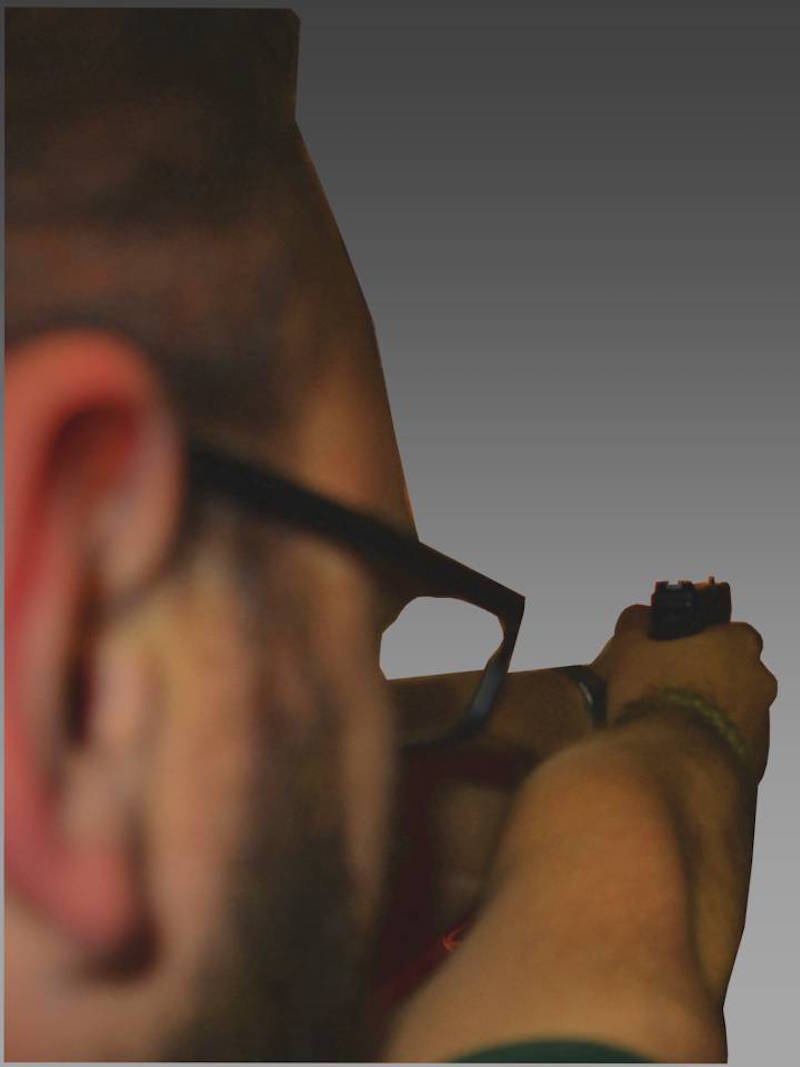 How do you find this "magical" point?
In essence, finding the natural stopping point is very simple:
- Assume the corresponding stance
- Close your eyes
- Rotate slightly left and right while standing/kneeling; deep breath in and out while in the prone position
- Return to the comfortable stance
- Open your eyes and check where the stopping point is relative to the target
- Correct body alignment accordingly (e.g. right-handed shooter standing; left-handed shooters accordingly):
- To the right of the target: move the left foot slightly back
- To the left of the target: move the left foot slightly forward
- Above the target: lower the upper body slightly
- Below the target: raise the upper body slightly
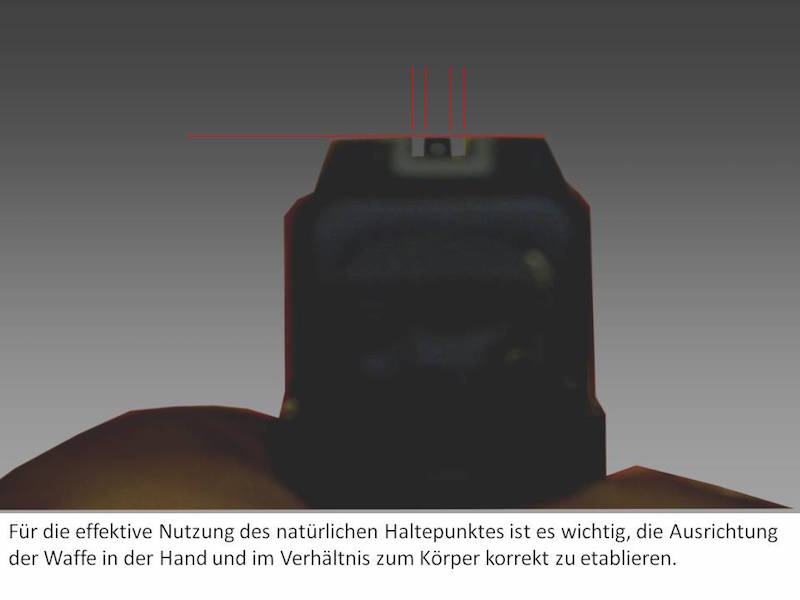 Attention: Always make slight corrections to the posture!
- Close your eyes and repeat the procedure until the target point and stopping point align
It is important to ensure that the posture is not "distorted" by unnecessary muscle strains.
If the muscles begin to be overstrained, a break is necessary!
Checking the natural stopping point is recommended before each training session, as this is the only way to effectively imprint muscle memory. This is possible both in live firing and dry firing training (see: Part 12 - Home Training).
Using this method enables actual results to be achieved in a short period of time, as focus and energy can be directed towards other aspects.
The stress resistance and thus the safe handling are proven to be improved by using the natural stopping point, and the positive feeling of success promotes motivation.
 In this sense: Stay safe
Khi Pa
Part 1: All under control
Part 2: The stance
Part 3: The natural stopping point
Part 4: The eye dominance
Part 5: The trigger work
Part 6: The workspace
Part 7.1: Aim, the Gretchen question
Part 7.2: Aim, all about the target point
Part 7.3: What to do with riflescopes
Part 8: Safe loading techniques for pistols and revolvers
Part 9: Safe loading techniques for shotguns
Part 10: Safe loading techniques with self-loading rifles
Part 11: All about equipment
Part 12: Home training
KL STRATEGIC online: http://kl-strategic.com
KL STRATEGIC on FACEBOOK: www.facebook.com/KL-STRATEGIC
The first 5 parts of the series will be fully available on SPARTANAT in the coming weeks. Please be patient, dear readers.
SPARTANAT is the online magazine for Military News, Tactical Life, Gear & Reviews.
Send us your news: [email protected]
Ad
similar
Get the weekly SPARTANAT newsletter.
Your bonus: the free E-Book from SPARTANAT.
