Get the weekly SPARTANAT newsletter.
Your bonus: the free E-Book from SPARTANAT.

The Startup Scene Meets the Defense Industry
The Bits & Pretzels startup festival in Munich, held from September 28-30, 2026, spotlighted defense innovation, attracting 7,500 participants and featuring a dedicated "Defense Area." Jan Hesselbarth emphasizes the need for collaboration between startups and the government amidst growing capital availability and evolving procurement processes.

From September 28 to 30, 2026, the startup festival Bits & Pretzels took place in Munich under the theme “Human After All.” According to the organizers, the event drew approximately 7,500 participants and about 2,000 investors. Defense was no longer just a niche there, but a separate program block with 400 square meters of exhibition space and 20 hours of stage programming. Jan Hesselbarth was there, refreshing old connections, making new ones, and securing a concrete opportunity. In this SPARTANAT article, he explains what has been on his mind: the gap between available capital and access to government demand.
A startup festival with a defense wing
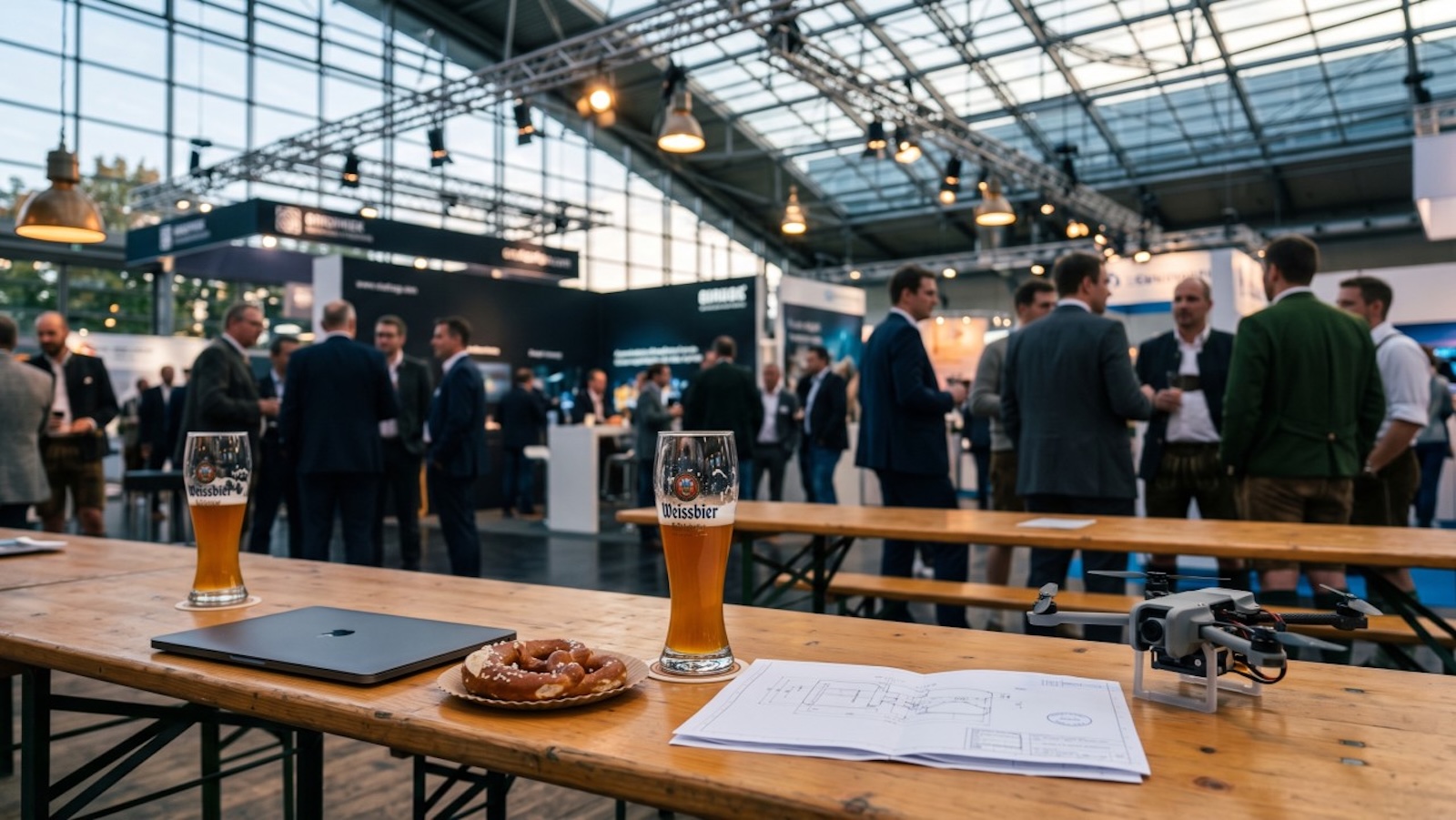
Bits & Pretzels has been the event where the German-speaking startup and investor scene gathers in the context of Oktoberfest since 2014. It has the atmosphere of a folk festival, with lederhosen and wheat beer, plus pitches and discussions about funding. The beer was good, but it remained a side note.
What’s new is the prominence of the defense theme. The organizers have announced a dedicated 400-square-meter “Defense Area” for 2026, focused on defense and dual-use innovation, featuring 20 hours of curated stage programming and over 50 speakers from the armed forces, industry, and the investor community. The area was curated by representatives from the Bundeswehr and the defense industry, among others, and the Bundeswehr’s Cyber Innovation Hub was involved as a partner.
The fact that a startup festival is dedicating this much space to the topic reflects capital trends. Dealroom.co reports a venture capital volume of approximately 3.5 billion U.S. dollars for German defense startups in the current year 2026, driven by a few large funding rounds at Helsing, Quantum Systems, STARK, and TYTAN Technologies. The presentation is a continuously updated overview without a fixed reference date; nevertheless, the order of magnitude is reliable: within two years, defense in Germany has gone from being a topic many funds avoided to one of the segments with the strongest capital base.
Capital is available; access is key
On the other hand, there is demand. The government’s draft budget for 2026 called for defense spending of 108.2 billion euros, of which 82.69 billion euros were allocated to Section 14 and 25.51 billion euros came from the Bundeswehr Special Fund, corresponding to a NATO quota of 2.5 percent.
Public procurement law lies between the supply of capital and the procurement budget. In this area, more has happened in 2026 than most discussions in Munich have reflected.
The Act on Accelerated Planning and Procurement for the Bundeswehr has been in effect since February 14, 2026. Direct contracts for Bundeswehr requirements are permitted up to the EU thresholds, which are currently 443,000 euros net for goods and services and 1 million euros for construction services below the EU thresholds. The law expressly permits advance payments to enable companies with limited capital and startups to participate in the competitive bidding process. The requirement to award contracts in lots is suspended until December 31, 2030, and the increased value thresholds apply until December 31, 2035. Innovation partnerships have been introduced for defense procurement; the Federal Public Procurement Tribunal has sole jurisdiction, and immediate appeals no longer have suspensive effect.
These regulations have a twofold effect. For a young company (such as WINGCOPTER, THYRA, or Autonomous Teaming) with a market-ready product in a six-figure order volume, the direct award significantly lowers the barrier to entry, and the advance payment resolves a liquidity problem that has previously caused series production launches to fail. For small and medium-sized suppliers, the suspension of the requirement to award contracts in lots weakens their position: large contracts can go entirely to general contractors, and the path to securing the contract then runs through subcontracting rather than through their own bid. The time limit until the end of 2030 is explicitly set as an evaluation window to assess the impact on small and medium-sized enterprises.
At the same time, the organization of meeting procurement needs is changing. On May 20, 2026, the Federal Ministry of Defense (BMVg) announced that theFederal Office for Equipment, Information Technology, and Use of the Bundeswehr (BAAINBw) will transition to a matrix structure organized along the dimensions of land, air, sea, cyber, and space, and that meeting procurement needs will be divided into three categories: Fast Track, Innovation, and Complex. The Innovation Center in Erding will gain a second location in Kiel, the establishment of which will be initiated before the end of 2026. For suppliers, this means that the category into which a project falls will determine the timeline and level of detail required more than the technology itself.
At the European level, on March 30, 2026, the Commission adopted a 1.5 billion euro work program to strengthen the European and Ukrainian defense industries, with the first calls for proposals opening on March 31, 2026, via the EU funding portal. Anyone seeking to secure funding there will need consortium partners, and it was precisely these partners who were walking the halls in Munich.
The result: Networks beat pitch decks
What impressed me over the three days was the lack of fanfare. No showboating, no status games. Decision-makers from industry, the armed forces, government agencies, and investment funds stood side by side at bar tables, crossing the usual sector boundaries. A conversation about sensor technology led to a discussion of manufacturing capacity; a discussion of manufacturing capacity led to a discussion of export controls. You don’t get this kind of cross-pollination at any trade show, because there, every industry sticks to its own.
Over those three days, I rekindled connections that had lain dormant for years, established new contacts, and developed a solid business opportunity. That’s why I consider this effort justified.
And at the same time, it’s an observation that worries me. The startup scene has capital, momentum, and talent. The Bundeswehr has needs and, since February, a set of tools that allows for faster contract awards. Nevertheless, I regularly see that both sides don’t know how to do business with each other. Founders underestimate how much preparation is required for prequalification, security clearance support, quality management, and documentation. Government agencies and established prime contractors underestimate how quickly an underfunded team disappears without a follow-up contract. A three-day event with a festival-like atmosphere won’t bridge this gap. It makes the gap visible, and that’s a start.
For small and medium-sized enterprises considering entering the market, I draw a simple conclusion from this: The next twelve to eighteen months represent a window of opportunity. The increased value thresholds are in effect, the suspension of contract awards runs until the end of 2030, EDIP funding will begin flowing in 2026, and the procurement organization is currently being restructured. Those who build relationships during this phase are working with the system. Those who wait until the structures are in place will encounter established supply chains.
JAN HESSELBARTH, as co-founder and managing partner of BRAVO SIX ADVISORY GmbH, is responsible for the defense division and brings over 20 years of operational and strategic leadership experience from the German Armed Forces, federal agencies, and the private sector. As a paratrooper officer and Joint Terminal Attack Controller (JTAC), he was responsible for territorial tasks and host nation support at the Hamburg Regional Command following a deployment in Kunduz, Afghanistan. His consulting portfolio includes NATO missions, programs involving up to 1,000 participants, training contributions for more than 5,000 Bundeswehr personnel, and co-authorship of a nationwide study on maritime security for the Federal Ministry of the Interior—a core topic in the context of KRITIS.
BRAVO SIX ADVISORY online
SPARTANAT is the online magazine for Military News, Tactical Life, Gear & Reviews.
Send us your news: [email protected]
Ad
similar
Get the weekly SPARTANAT newsletter.
Your bonus: the free E-Book from SPARTANAT.
