Get the weekly SPARTANAT newsletter.
Your bonus: the free E-Book from SPARTANAT.

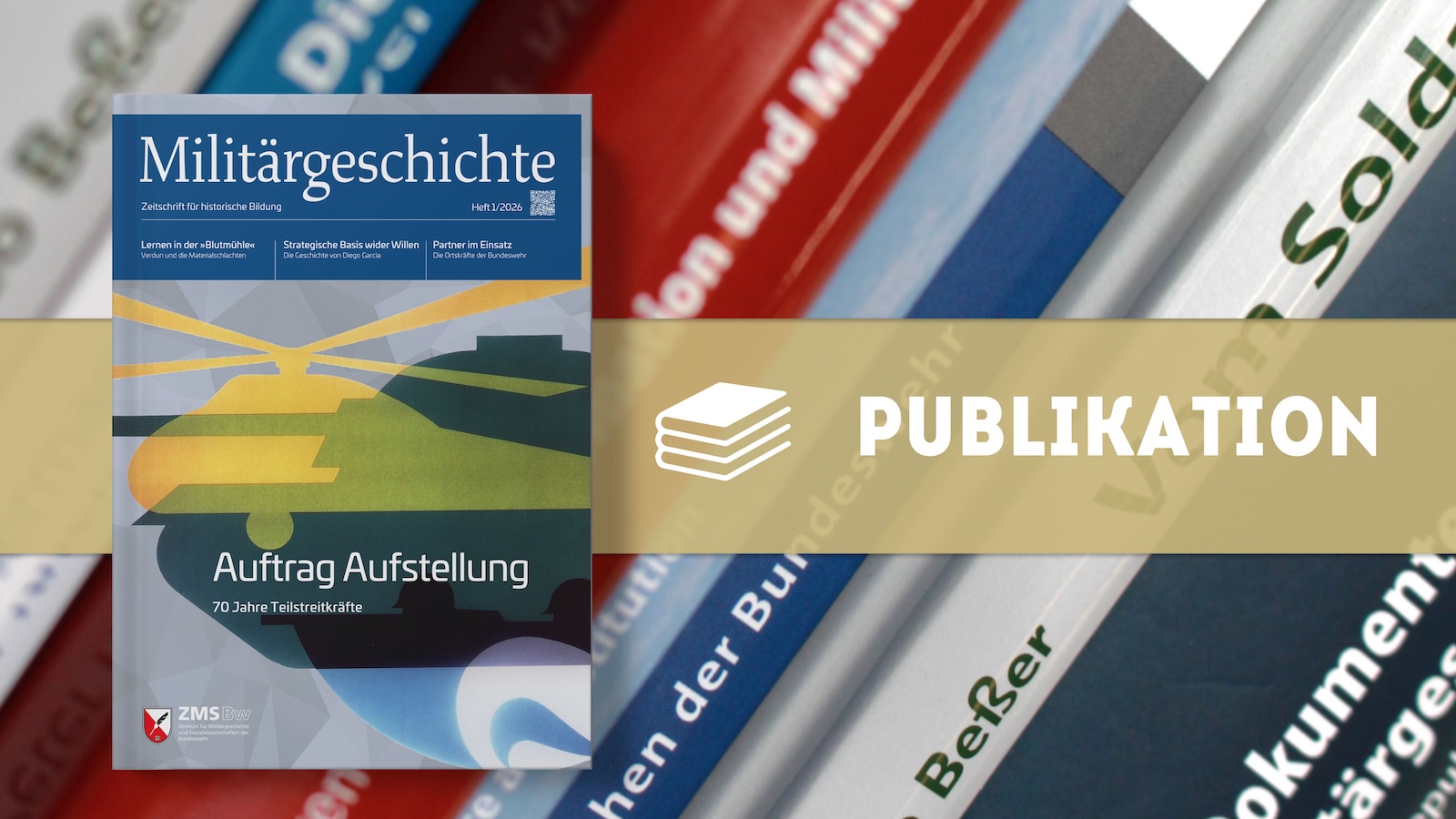
The new „Militärgeschichte“ 1/26
The latest issue of "Military History" celebrates 70 years of the German armed forces, examining their establishment and early challenges. It covers foreign missions in Cambodia and Somalia, the strategic significance of Diego Garcia, the historical context of women in the military, and the Battle of Verdun's impact on warfare.

70 years of the armed forces: The new issue of “Military History” focuses on the establishment of the German armed forces. It also covers the history of local forces of the German armed forces in Cambodia and Somalia, the history of the strategic US base Diego Garcia, and the Battle of Verdun.
70 years of the armed forces
On January 20, 1956, Chancellor Konrad Adenauer made the first visit to troops in the history of the Federal Republic. His visit to Andernach marked a historic moment. It was the beginning of a long and challenging process of establishment, which Mischa Bose examines in more detail in his article. Due to the complete demilitarization of Germany after the Second World War, the Bundeswehr had to be built up practically from scratch in many areas. And this had to be done under extreme time pressure, because during the Cold War the threat situation was acute and the enemy was only a few hundred kilometers away.
In the early years, there was some overlap between the new armed forces of the Federal Republic, the Bundeswehr, and the Federal Border Guard, particularly in terms of equipment and personnel. The first units of the Federal Border Guard were established as the “Federal Police” as early as 1951. When the Bundeswehr was founded in 1955, more than half of the personnel there transferred to the new armed forces. Klaus Storkmann explains in his article for “Militärgeschichte im Bild” (Military History in Pictures) that it is not always easy to distinguish between the two organizations.
Local forces in action
Several decades passed between these beginnings and the Bundeswehr's extensive foreign missions. From the outset, local personnel played a central role for the German armed forces in enabling them to carry out their missions in unfamiliar regions and cultures. However, the particular challenges associated with this cooperation did not first become apparent in Afghanistan. They were already evident during the Bundeswehr's first missions in Cambodia and Somalia, as Torsten Konopka and Emma Bessi explain in their article.
Diego Garcia
The small island of Diego Garcia is a prime example of how a country's strategic interests can sometimes manifest themselves in faraway places. It came under British rule as early as 1810, and in 1965 the British government handed Diego Garcia over to the US as a military base. During the Cold War, the US stationed B-52 long-range bombers there. Its proximity to Africa, the Gulf region, and China gives the island a high strategic value that would be a bitter loss to relinquish. Against this backdrop, Gerhard Altmann provides a brief overview of the turbulent history of colonization and decolonization of the small coral atoll in the Indian Ocean.
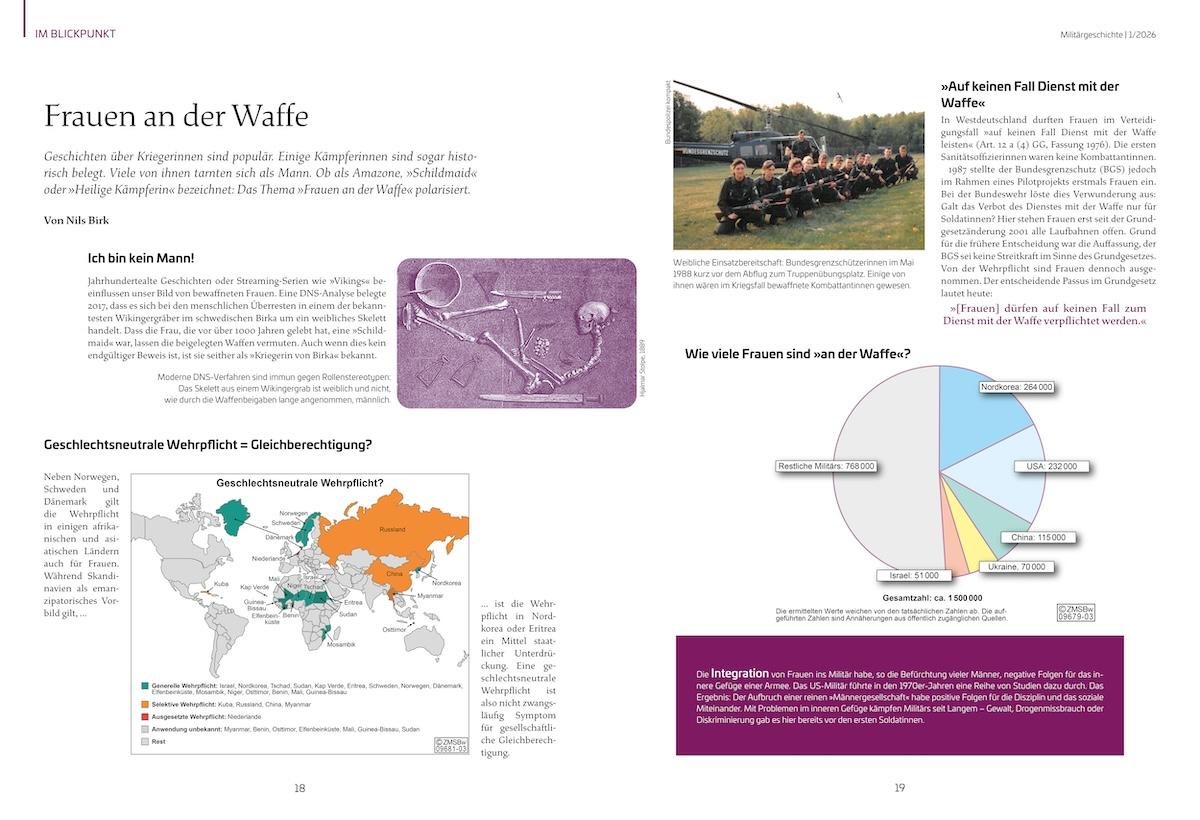
Women in the military
Discussions about the reintroduction of compulsory military service currently revolve around the question of whether women should also be eligible for military service. However, this is currently prevented by the Basic Law, which only subjects men to compulsory military service. In his article for the “In Focus” section, Nils Birk shows that “women in the military” is a controversial topic that has been debated for thousands of years.
Verdun
Some battles have been burned into the collective memory. One of these is the Battle of Verdun, which began 110 years ago in February 1916 and later went down in history as the “blood pump” or “bone mill” of Verdun. The fighting marked the beginning of large-scale battles of attrition, from which the German army learned tactical lessons about combined arms warfare. But the toll in human lives for this learning process was high: hundreds of thousands of soldiers on both sides fell in the fighting, and their memory is still preserved today in the Douaumont Ossuary. An analytical overview by Christian Stachelbeck.
The issue is available for free download on ZMSBw website.
SPARTANAT is the online magazine for Military News, Tactical Life, Gear & Reviews.
Send us your news: [email protected]
Ad
similar
Get the weekly SPARTANAT newsletter.
Your bonus: the free E-Book from SPARTANAT.
