Get the weekly SPARTANAT newsletter.
Your bonus: the free E-Book from SPARTANAT.

The data field
The article analyzes the implications of Germany and Ukraine's agreements on military data exchange, highlighting the Ukrainian Delta battle management system and Palantir's potential influence on German military AI. It discusses Europe's response, the importance of data sovereignty, and the need for European defense solutions to remain competitive.

Theresa Locker has published a good analysis for Tagesspiegel Background Security & Defense, which I recommend everyone in this market read: It deals with the Ukrainian Delta battle management system, the Brave1 data room, and the question of what the Bundeswehr is actually purchasing there. The article is well-researched, nuanced, and poses the right key question: Is Palantir gaining indirect influence over military AI in Germany through the back door of data cooperation?
What It’s About
On April 14, 2026, Germany and Ukraine concluded a package of agreements, including an agreement on the exchange of combat data. Germany gains access to combat-generated data from the Ukrainian Delta battle management system and related platforms; in return, usage data from German systems such as the PzH 2000, RCH 155, and IRIS-T, among others, will be included in the joint analysis.
The package also includes a military aid package worth approximately four billion euros and a joint venture for drone manufacturing. Chancellor Merz explicitly linked this to the prospect that a European system developed jointly with Ukraine could strengthen the continent’s strategic independence. During his visit to Kyiv on May 11, Defense Minister Pistorius announced that the Bundeswehr would work intensively with the Ukrainian battle management system in the second half of the year; he explicitly left open the possibility of a later introduction.
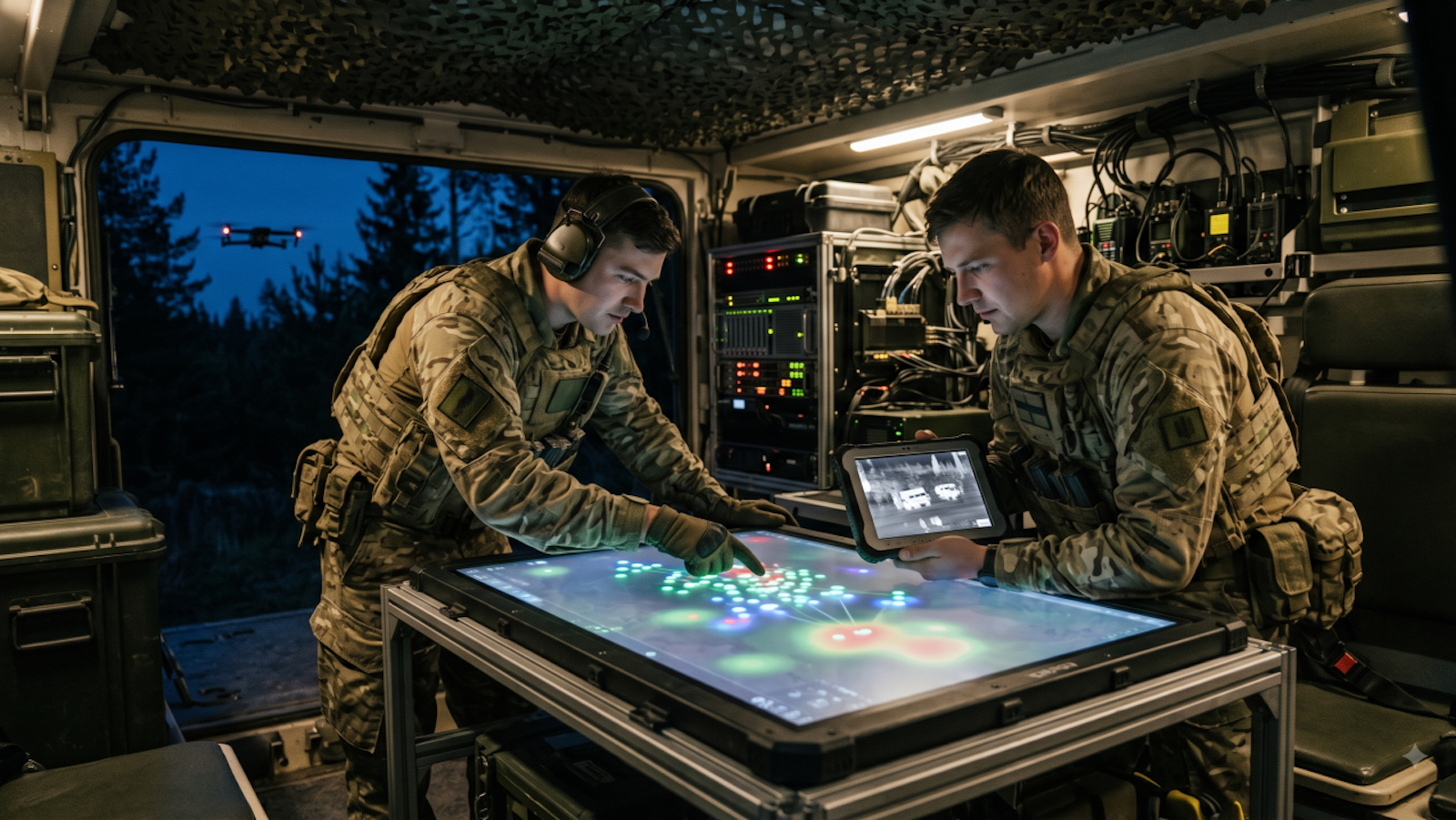
Theresa Locker precisely describes what Delta does: The cloud-based system fuses sensor data, drone feeds, intelligence information, and reports from verified civilians into a real-time situational picture; it also functions offline on tablets and smartphones at the front lines and reduces the time from target detection to engagement from 20 to 30 minutes to three to ten minutes. According to this information, the AI module “Avengers” classifies approximately 12,000 targets per week from video streams and continuously learns from combat data. Delta emerged in 2014 from a volunteer IT community and has been supported by the NATO C4 Trust Fund since around 2017. In January 2026, the Brave1 Dataroom was added: a platform with historical combat datasets for training proprietary AI models, built in collaboration with Palantir, with Ukraine controlling access.
A Clarification
There is one point in the article that warrants a correction, and I am making it because precision is our common currency in this debate. The text states that ten Ukrainian drone pilots “checkmated two NATO battalions, or 16,000 soldiers,” during the NATO exercise Hedgehog in Estonia. The figure of 16,000 refers to the total strength of the exercise: more than 16,000 soldiers from twelve nations participated in Hedgehog 2025. Depending on their structure, two battalions comprise several hundred to over a thousand soldiers each, totaling just under 10 percent of that number. A fact-check by Defence24 also clarifies what actually happened in the exercise scenario: Within half a day, around ten operators simulated the destruction of 17 armored vehicles and approximately 30 additional hits over an area of less than ten square kilometers; the two battalions were subsequently declared no longer combat-capable according to exercise standards.
The corrected figure in no way diminishes the finding. Ten operators with Delta connectivity who take two NATO battalions out of action within twelve hours are proof enough of the superiority of a data-driven situational awareness over conventional command and control processes. Anyone who recounts this lesson using rounded-up figures provides skeptics with a point of attack that the matter itself does not offer. Precisely because the finding is uncomfortable, it should be presented in an unassailable manner.
The Palantir assessment is correct
I fully agree with the analytical core of the article, which lies in the concept of ontology: Who defines what is considered real and relevant to action on the battlefield? Delta aggregates heterogeneous sources without a central authority on truth; the situational picture emerges as a collective perceptual effort, and the decision remains with humans at the lower levels. Palantir operates using a centralized analytical approach: algorithms cleanse, fuse, and prioritize data, and the basis for this prioritization remains opaque to the user. Anyone who adopts such an ontology is adopting a commercial filtering structure for their own situational assessment. This distinction is precise, and it is the standard by which every procurement decision in this field should be measured.
The facts regarding this in Germany: Vice Admiral Dr. Thomas Daum, Inspector of Cyber and Information Space, described the introduction of Palantir software into the Bundeswehr as “unimaginable” at the end of April 2026, stating that allowing industry employees access to the national database was out of the question. At the same time, NATO has been using Palantir’s Maven Smart System since 2025—maintained by Palantir personnel—and the Bundeswehr accesses it through NATO structures. Locker’s conclusion is therefore logical: If Germany trains its own models on Brave1 datasets and the results flow back into alliance systems via NATO channels, Palantir’s ontology gains indirect influence even where the software has been officially excluded. The front door is locked, but the window is open.
It is noteworthy how Ukraine itself is handling this issue of dependency. Kyiv has derived a clear architecture from the experience in Kherson in 2022, when deactivated Starlink terminals hampered operations: Delta remains Ukrainian-owned and developed; Palantir is a partner with defined cooperation agreements and plays no operational role; and control over access to the data room remains national. A country at war, under extreme pressure, is maintaining this discipline of sovereignty. This serves as a model for Germany—and it comes from Kyiv.
There Are European Solutions
Another fact is that Europe is by no means left empty-handed on this issue. Following the rejection of Palantir, the Bundeswehr is evaluating European providers for its cloud and AI initiatives; those mentioned in reports include Helsing, whose software is already in use by Bundeswehr units; SAP, with sovereign cloud offerings; and Atos, as well as smaller providers from Germany and France. The Federal Office for the Protection of the Constitution has opted for an alternative to Palantir. At the same time, experts rightly point out that a single product is not enough as a replacement; what is needed is an ecosystem comprising data access, integration capabilities, and an operational model. And with the German-Ukrainian agreement, the most valuable raw material for this ecosystem is now on the table: combat-generated training data from three years of war—data that no U.S. provider and no laboratory in the world can replicate.
The building blocks exist. What I haven’t seen yet is the decision to put them together.
The Decision That Lies Ahead
This brings us to the implication that goes beyond the scope of this article, and it is directed at the German and European defense industries—both established companies and startups.
Many can build drones today. This is a deliberate oversimplification, as engineering, certification, mass production, and hardening against electronic warfare remain challenging. Nevertheless, the direction is right: airframes, engines, and optics have largely become commodities; Ukraine manufactures millions of them per year, and the German-Ukrainian joint venture demonstrates how quickly production capacity can now be built up. The capability that makes the difference in combat lies in the software: in the data fusion that, for example, creates a situational picture from 150,000 video feeds; in the algorithms that classify 12,000 targets per week; and in the architecture that shortens a kill chain from 30 minutes to three. Hedgehog demonstrated exactly that: the difference was made by ten operators with the better data picture, while the vast majority of platforms were on the other side.
This leads to a decision that German defense contractors cannot avoid: Do we leave the data field to the Palantirs of this world, or do we build the European solution?
Anyone who manufactures drones, effectors, or sensors today and treats the data layer as a mere supplier detail will tomorrow be an interchangeable hardware supplier in the value chain of a foreign software ecosystem. Whoever controls the data layer helps define the ontology of the battlefield. In the long run, there is little room between these two positions.
And because the word “emancipation” is quickly misunderstood, I’ll say precisely what I mean. It is in Europe’s interest to remain allied with the United States—in NATO, in intelligence cooperation, and in industry. However, being on equal footing within this alliance requires having our own capabilities. In negotiations, only those who have their own options can say “no”; those who don’t call their consent “partnership” but mean “necessity.” Ukraine has demonstrated how the two go hand in hand: close cooperation with U.S. providers while simultaneously retaining ownership of systems, data, and access control. It is precisely this combination that describes what Europe should strive for in defense. The April agreement, the existing European providers, and the wealth of data from Kyiv together create a window of opportunity. It is open—and, as experience shows, it will remain open for only a short time.
JAN HESSELBARTH, as co-founder and managing partner of BRAVO SIX ADVISORY GmbH, is responsible for the defense division and brings over 20 years of operational and strategic leadership experience from the German Armed Forces, federal agencies, and the private sector. As a paratrooper officer and Joint Terminal Attack Controller (JTAC), he was responsible for territorial tasks and host nation support at the Hamburg Regional Command following a deployment in Kunduz, Afghanistan. His consulting portfolio includes NATO missions, programs involving up to 1,000 participants, training contributions for more than 5,000 Bundeswehr personnel, and co-authorship of a nationwide study on maritime security for the Federal Ministry of the Interior—a core topic in the context of KRITIS.
BRAVO SIX ADVISORY online

SPARTANAT is the online magazine for Military News, Tactical Life, Gear & Reviews.
Send us your news: [email protected]
Ad
similar
Get the weekly SPARTANAT newsletter.
Your bonus: the free E-Book from SPARTANAT.
