Get the weekly SPARTANAT newsletter.
Your bonus: the free E-Book from SPARTANAT.

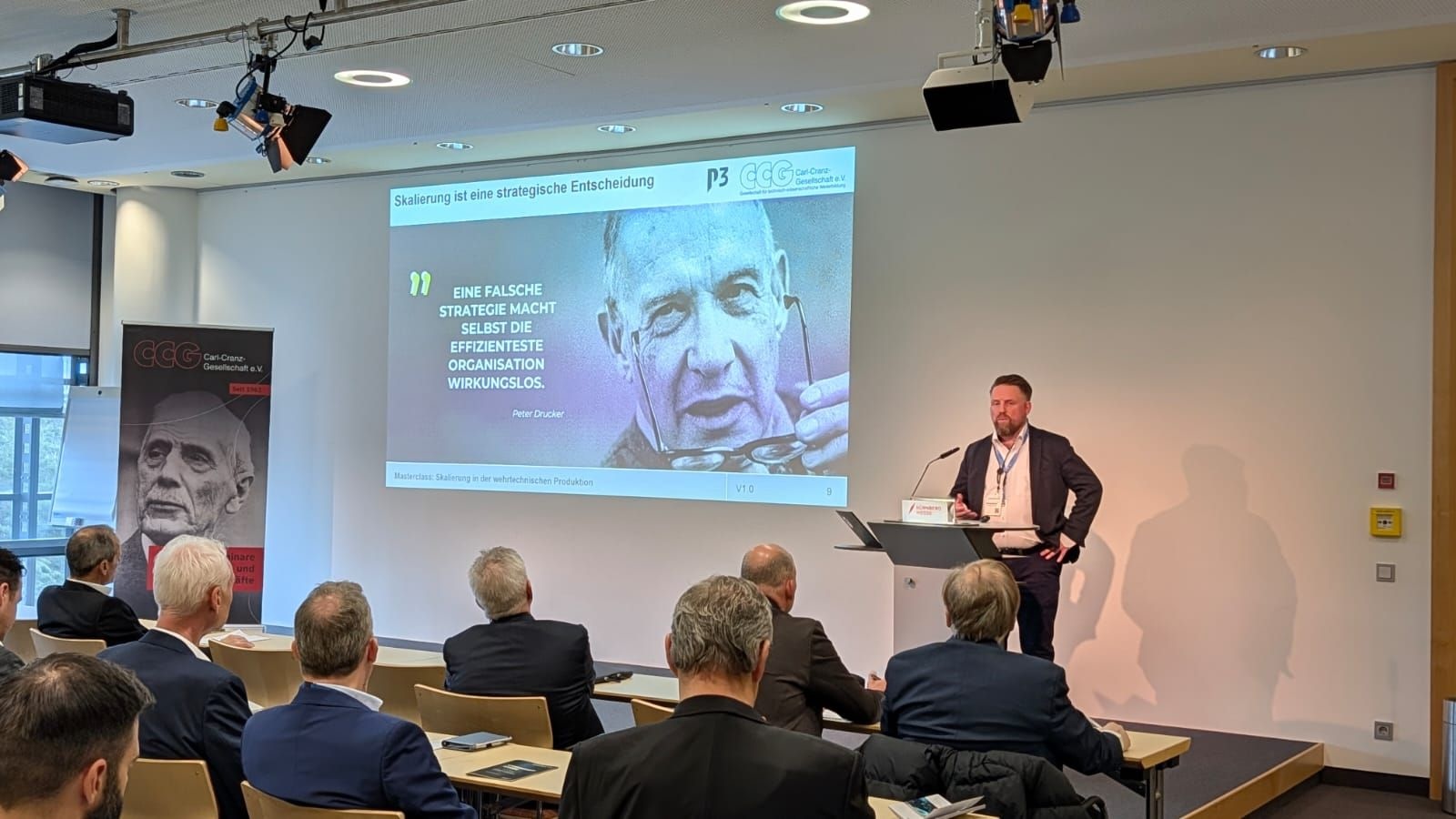
Scaling in defense technology production
The seminar by the Carl Cranz Society on scaling defense production emphasized strategic clarity over mere manufacturing adjustments. It highlighted the need for standardized, modular structures and adaptable production systems to address the unique challenges of defense technology, contrasting it with automotive practices.

Discussions and efforts to scale up defense production are a major focus for policymakers and industry. Political pressure regarding availability, delivery capacity, and industrial resilience is high; at the same time, many companies are reaching limits that cannot be overcome simply by adding more staff, more shifts, or more investment. The message from consultants flocking to leading systems integrators is: “Automotive goes Defense.” The approach seems obvious, as the automotive sector offers a wealth of experience. At the same time, capacity is becoming available in what was once the driving industry.
As part of ENFORCE TAC 2026, the Carl-Cranz-Gesellschaft offered, among other things, a two-day seminar on scaling in defense production. An abridged version was also offered as a 90-minute “masterclass.” The materials are available for download HERE.
344 slides in 15 hours, presented by nearly a dozen speakers from 3 companies—the format offers a comprehensive and in-depth look at the experience of the consulting firm P3, the current state of research at Fraunhofer IGCV, and the capabilities of the Franconian plant engineering firm M.A.I. GmbH & Co KG.
The key takeaway from the seminar lies less in individual technological aspects than in the structure and guiding principles conveyed: Scaling does not begin in manufacturing, but with strategic clarity. First, the strategy defines the target vision. Products and processes then create the necessary stability. The production system provides structure for implementation. Only then does the organization consistently follow the process. This sequence is not an academic subtlety, but is crucial in practice. Anyone who starts with layout, automation, or line planning without having sufficiently clarified the target architecture, product logic, and maturity level risks optimizing in the wrong direction. Christian Kienzle, a partner at P3 and a retired Oberleutnant in the Mountain Infantry, never tires of pointing this out time and again.
Delivery Capability as a Strategic Factor
Why is this particularly relevant for the defense industry? Unlike in many civilian industries, delivery capability here is not merely an operational issue, but a strategic factor. Available systems are more relevant to security policy than “ordinary cars.” Dependencies, single points of failure, and supply chains that do not grow in sync are thus not just efficiency problems, but real supply risks. Added to this is the fact that demand is politically driven, erratic, and only partially predictable. The speakers put it succinctly: project logic meets supply reality. This is precisely where the risk of a disconnect between technical project success and industrial supply capability lies.
A second valuable insight was the distinction between project and product or platform. Industrial scaling cannot result from constant project micromanagement but requires repeatable, standardizable, and modular structures. This is a critical issue for defense technology. Many programs have historically been strongly project-driven, often customized to specific customers and shaped by changing requirements. Scaling, however, demands a different mindset: less optimization for individual cases, more platform capability; fewer custom solutions, more manageable variance; less heroic improvisation, more reproducible processes.
Two images from publicly available media offer a glimpse into the production of German infantry fighting vehicles and Russian T-72 tanks. Custom manufacturing versus near-series production: The difference lies not only in the quantity but in the entire system architecture: unplanned material provision versus precise, on-time supply; no pre-assembly versus structured subassemblies; manual, sequential craftsmanship versus a coordinated assembly line.
Scaling Levels and Adaptation Needs
Following the strategic classification and fundamentals of production scaling, the content delved deeper with a 360-degree view of the various business units. Production does not grow in isolation. Depending on the scaling level, sudden adaptation needs arise in various business units. Each division was examined in depth as part of a “deep dive”: Development, Industrial Engineering, Production, Quality, Maintenance, Logistics, Supplier Management, Purchasing, Plant/Location, Organization/Human Resources, IT Infrastructure, and Controlling. Anyone who views scaling solely as a manufacturing issue underestimates the systemic nature of the task.
Particularly interesting was the classification of different production forms for determining a company’s location and objectives. Between custom manufacturing, artisanal production, small-batch production, large-scale production, and mass production, not only do unit volumes and unit costs change, but also standardization, infrastructure requirements, investment logic, and supply chain demands. For many defense technology products, the target state will not be classic mass production, but rather a robust, controlled small- or medium-batch production with high repeatability, defined variant logic, and resilient supply chains. This is precisely why the unreflective reference to the automotive industry is problematic. Not every lesson from the automotive industry is wrong—but not every target architecture of the automotive industry makes sense for defense.
This applies particularly to the topic of automation. The seminar outlined a sensible methodological path here: First, assess suitability for automation; then eliminate, simplify, and stabilize; only then mechanize, partially automate, systematize, and operate based on data. Automation is not an end in itself. It requires stable and economically relevant processes. Anything that does not generate direct value should be removed first. The product and process must be standardized in such a way that variations, variation, and errors are systematically controlled. Only on this basis is deeper automation worthwhile.
Procurement of Equipment and Machinery
Equally important is a rather sober assessment of the procurement lead times for equipment and machinery. Depending on complexity, there are significant time differences between standard equipment, customized solutions, and genuine new developments. Individual machines generally take between six and twelve months, integrated production lines tend to take twelve to eighteen months, and large-scale equipment or factory structures can sometimes take significantly longer. Added to this are classic project risks such as missing validated process parameters, delayed long-lead orders, unavailable components for FAT and commissioning, inadequately managed subcontractors, or a lack of skilled personnel for PLCs, robotics, and startup.
The concept of the adaptable production system was also intriguing. Especially in uncertain markets and with medium production volumes, it is not only maximum efficiency that matters, but also structural adaptability. Sequential assembly lines, bypass solutions, partially decoupled areas, or parallel autonomous lines may be more sensible than an overly integrated overall system, depending on the level of maturity and production volume. This is particularly relevant for defense technology because production volumes, customer requirements, and program schedules are often significantly more volatile than in traditional consumer goods markets.
The guide is available for download HERE.
In addition, the seminar highlighted various approaches to scaling: scaling in development, in speed, in variant management, and in production. This differentiation is helpful because it corrects a common misconception. Scaling does not automatically mean only “higher production volumes.” It can also mean reducing development costs through reuse, shortening time-to-market, managing product complexity via modules and modular systems, or making production processes more resilient through standardization and repeatability. For many defense technology companies, it is precisely this multidimensionality that is likely to be the more practical approach.
From an industrial perspective, however, a critical assessment remains necessary. The methodological models were robust, but there was a lack of robust case studies from the defense industry. Furthermore, strategic decisions in defense technology production and procurement are not made by industry alone. Public contracting authorities, national regulations, security clearance, obsolescence management, offset requirements, country-specific guidelines, and program-related control logics—right up to requirements from the V-Modell XT—shape the scope for action. This is precisely why maturity models and industrialization logics cannot be transferred one-to-one from other industries.
The seminar established a clear framework and provided important food for thought: scaling begins with strategic clarity, requires a company-wide 360-degree perspective, and must view automation solely as a consequence of stable processes. The distinctions between project and product, between custom manufacturing and series production logic, and between different approaches to scaling are particularly valuable for defense technology practice.
At the same time, it must be noted: Defense technology does not simply need more automotive rhetoric, but rather more robust, industry-specific examples of industrialization. What matters is not whether defense can become “like automotive.” What matters is where industrial excellence from other industries can be meaningfully adapted—and where the specificities of public procurement, regulatory frameworks, and military use demand their own solutions.
Through its offerings, the Carl Cranz Society (CCG) makes a significant contribution to knowledge transfer and the exchange of experience within the industry.
The Carl Cranz Society (CCG) offers a wide range of defense technology seminars for professional development. HEREyou can find the current program.
SPARTANAT is the online magazine for Military News, Tactical Life, Gear & Reviews.
Send us your news: [email protected]
Ad
similar
Get the weekly SPARTANAT newsletter.
Your bonus: the free E-Book from SPARTANAT.
