Get the weekly SPARTANAT newsletter.
Your bonus: the free E-Book from SPARTANAT.

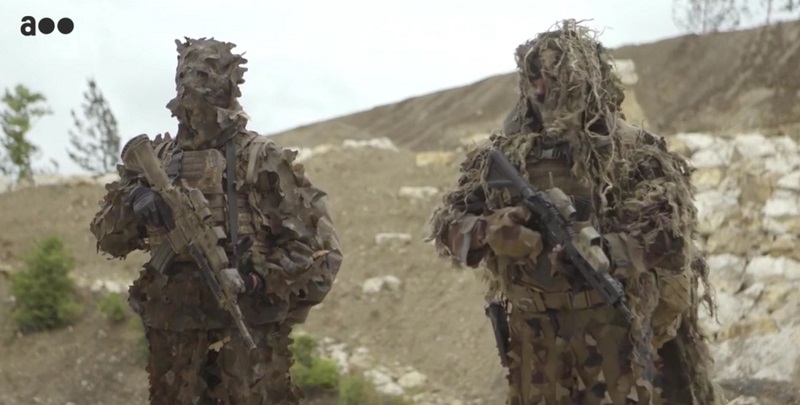
Armor (7): Trade with security
The largest international arms fair, Eurosatory in Paris, focuses on security and protection, with arms companies now marketing themselves as security providers. The global demand for arms is increasing due to political tensions and international conflicts, leading to a rise in weapon sales. Despite concerns about weapons falling into the hands of terrorist groups, the arms market appears clean and transparent at Eurosatory, targeting a broad audience with a variety of defense products. Austria's role in the arms market is also explored in an ongoing series.

The exhibitors at the largest international arms fair, Eurosatory in Paris, prominently display the themes of security and protection on their advertising banners. While the market used to focus on the military, arms companies now increasingly market themselves as security providers.
The revenue of the world's 100 largest arms companies in weapons and military services was $374.8 billion in 2017, with $77 billion coming from sales in Western Europe. The demand for arms is increasing globally, as strongly as it has since the end of the Cold War.
This is partly because several states have modernized their military with new weapon systems, and partly due to ongoing political tensions. The more international conflicts there are and the greater the fear of terrorism is, the more weapons and military services are sold. Attacks like those on the offices of Charlie Hebdo, the Christmas market in Berlin, or the promenade in Nice have contributed to the increasing fear of attacks.
The exhibitors at the largest international arms fair, Eurosatory in Paris, prominently display the themes of security and protection on their advertising banners. While the market used to focus on the military, arms companies now increasingly market themselves as security providers. The business with weapons and defense seems clean and transparent here.
The trade in products used in crisis and emergency situations does not appear to be a necessary evil to the layman at Eurosatory; it almost seems as if there is only a peripheral connection to military equipment. The fair now targets a broad audience, with more than 1,700 exhibitors presenting their best – from gold-plated assault rifles to virtual-reality shooting training to bazookas.
Weapons serve not only defense but also end up in the hands of terrorist groups. Purchasing states of arms are obligated not to resell their purchases, but state control in this regard is rather lax.
Addendum series on Austria's role in the arms market:
Introduction on SPARTANAT: Austria's Role in the Arms Business: Creating Weapons for Peace?
Part 1: Who Austria Supplies
Part 2: Austria's Armed Forces Will Track Combat Agents for the EU and NATO
Part 3: In Context: Austrian Arms – Weapons for Peace?
Part 4: The Austrian Arms Complex
Part 5: Warfare 3.0: Will Robots Replace Soldiers Soon?
Part 6: How Austria Delivers Military Goods to War Zones
Part 7: Trading in Security – The Fight Against Terrorism as a Business Model
More to come...
This article was first published on ADDENDUM. Copyright Text: ADDENDUM. Images: ADDENDUM. Video contributions, graphics, and audio contributions: ADDENDUM.
ADDENDUM online: www.addendum.org
SPARTANAT is the online magazine for Military News, Tactical Life, Gear & Reviews.
Send us your news: [email protected]
Ad
similar
Get the weekly SPARTANAT newsletter.
Your bonus: the free E-Book from SPARTANAT.
