Get the weekly SPARTANAT newsletter.
Your bonus: the free E-Book from SPARTANAT.

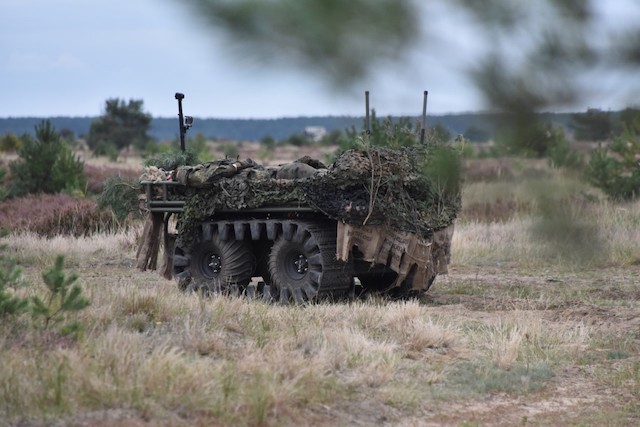
Probot: Flexible with the infantry
The Bundeswehr conducted field trials of Unmanned Ground Vehicles to support dismounted forces. Elbit Systems Deutschland's Probot demonstrated capabilities in logistics, casualty evacuation, reconnaissance, and combat support.

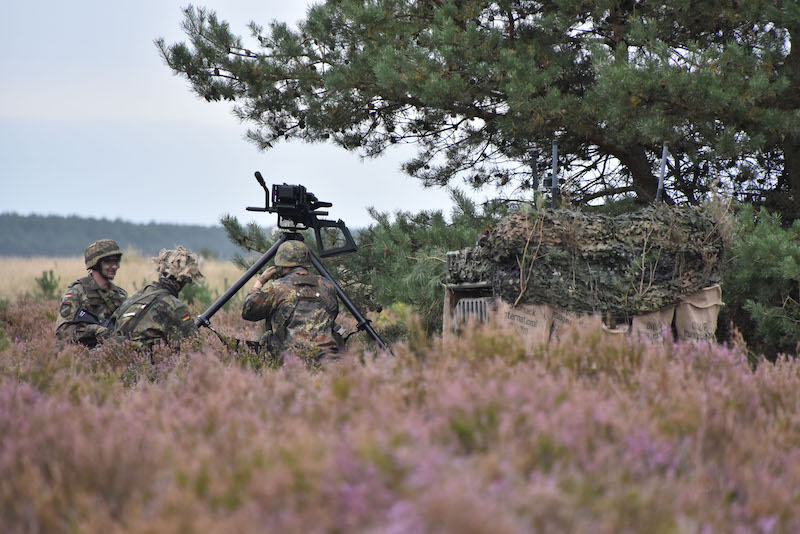
The Bundeswehr has conducted field trials of unmanned ground vehicles - known in English as "Unmanned Ground Vehicles" or UGVs. The lead agency for the F&T study "Unmanned Ground Vehicles to Support Dismounted Forces" was the Army Development Office in collaboration with the Fraunhofer Institute FKIE. Support was also provided by the infantrymen of the 6th Company of the BMVg Guard Battalion and the BAAINBw. The field tests were carried out at the Jägerbrück training area in Torgelow.
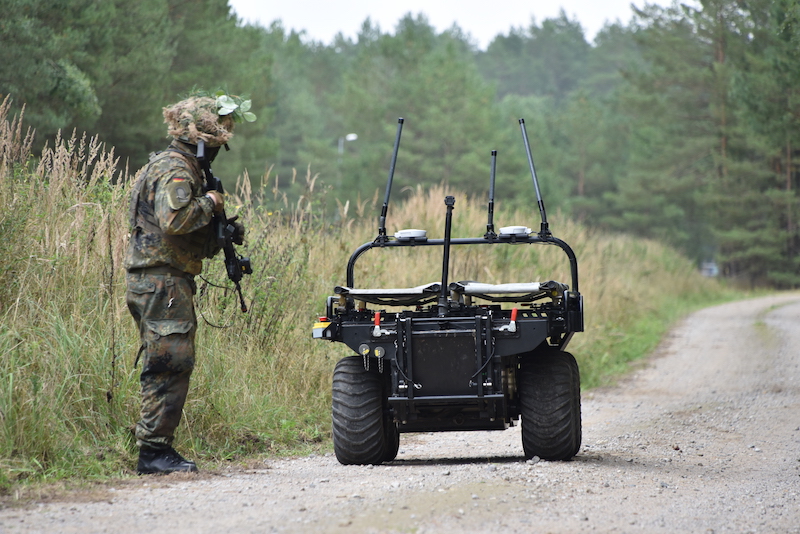
As part of the study, various UGVs were tested and evaluated in realistic scenarios. The criteria such as driving characteristics and teleoperation/remote control were supplemented by the usability of autonomous functions in mission-relevant scenarios. The highlight was the combat shooting, in which the soldiers were supported by the participating UGVs.
Professional Robot in Use
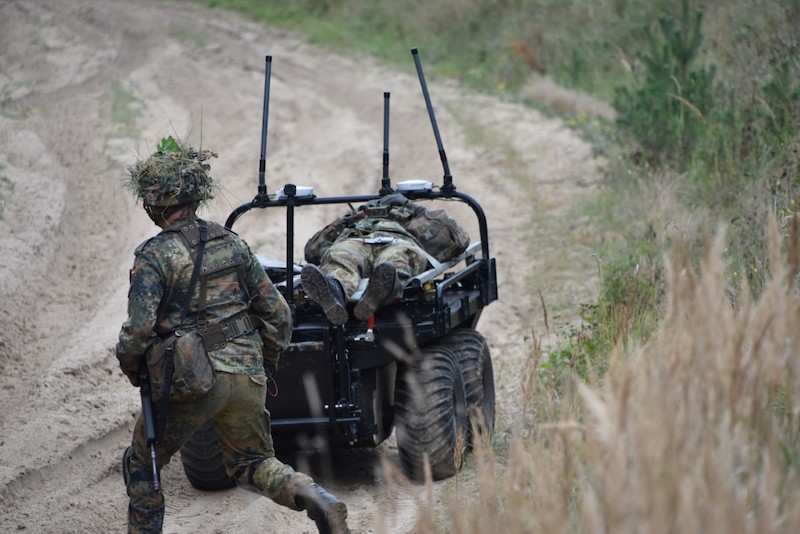
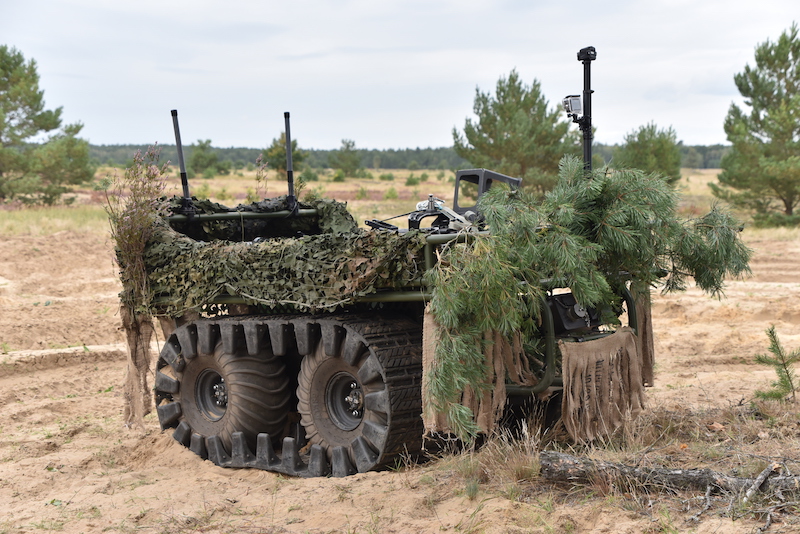
Elbit Systems Deutschland participated with two Probot V2 models once again. The UGV Probot (Professional Robot) is a terrain-capable carrier and reconnaissance robot designed to support dismounted troops and enhance their effectiveness. To relieve the operational forces, the Probot is capable of transporting casualties lying down, rucksacks, or other loads (e.g., ammunition, spare parts), or incorporating various sensors (electro-optical, CBRN, Electronic Warfare) for reconnaissance. During the current test, in addition to normal loads, heavy machine gun ammunition (GraMaWa) was also transported.
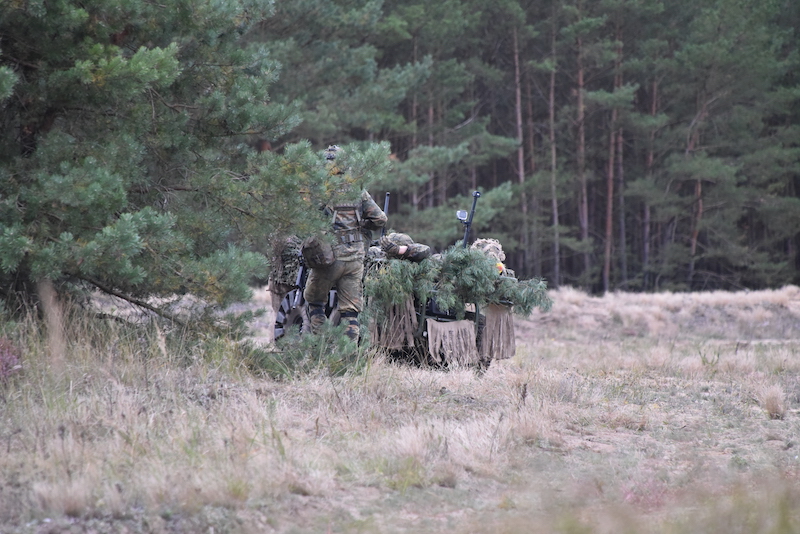
Direct deployment of the GraMaWa from the Probot is also possible, but was not tested in live fire. The concept of operations (CONOPS) envisions the Probot being able to transport smaller UGVs or unmanned aerial vehicles (UAVs) into a target area to conduct reconnaissance missions and significantly increase their range. The Probot can also be used as a relay station for command posts to extend range and standoff capability.
As part of the F&T study, the Probot demonstrated its capabilities as a flexible Cargo Mule. In addition to off-road capability and teleoperated driving, the soldiers were able to assess the practicality of the autonomous functions "Follow-Me" and waypoint navigation firsthand in scenarios involving logistics and casualty evacuation. The use of multiple Probots in a convoy is also possible. High flexibility is a key factor in operations. Furthermore, the Probot stood out for its low entry barrier. There is no need for extensive user training for deployment. The system is intuitive and highly user-friendly. Due to its electric drive, allowing for up to 24 hours of operation, the acoustic and thermal signature is extremely low, making detection by adversaries difficult.
Probot Capabilities
Thanks to its compact dimensions (H/W/L: 195x133x112 cm), the Probot can be used both indoors and in open terrain. The vehicle weighs 435 kg and can carry a maximum payload of 750 kg. The Probot is highly mobile and can traverse various types of terrain such as sand, water, thickets, rubble, and obstacles, with protection equivalent to IP67. To enhance off-road capability, the 4x4 vehicle can be equipped with a rubber track kit. The maximum speed is 12 km/h. A 48 V battery according to military standards serves as the power source.
In line-of-sight operation, the range is 1,500 m. In addition to GPS, the vehicle is equipped with day/night cameras, including zoom function, for a 360° panoramic view - these can also record for reconnaissance purposes. A 360° near-infrared illumination (NIR) is installed for support. Communication is via a secure mobile ad-hoc IP network with mesh data connectivity. Control and programming are done through a Ruggedized Operator Control Unit (ROCU-7), weighing 2.3 kg, capable of operating all types of unmanned vehicles - aerial, land, sea - and can also be used in night vision mode.
ELBIT SYSTEMS DEUTSCHLAND Website
SPARTANAT is the online magazine for Military News, Tactical Life, Gear & Reviews.
Send us your news: [email protected]
Ad
similar
Get the weekly SPARTANAT newsletter.
Your bonus: the free E-Book from SPARTANAT.
