Get the weekly SPARTANAT newsletter.
Your bonus: the free E-Book from SPARTANAT.

OPINION: Privatize hybrid wars
Erik Prince highlights the necessity of unlocking America's hidden capabilities from the private sector to restore lost credibility and achieve deterrence. Hybrid wars can be utilized effectively using private contractors to avoid the failures seen in Afghanistan.

The debacle in Afghanistan underscores the need to unleash America's hidden capabilities from the private sector, according to Erik Prince exclusively on SPARTANAT. Only in this way can lost credibility be restored and deterrence be achieved. Hybrid wars would offer themselves for this purpose, no longer leaving them to state actors who are neither willing nor efficient enough to sustainably lead these conflicts.
Four and a half years ago, I offered the Trump administration a way out of the cycle of failure that America was facing in Afghanistan. A similar package was previously presented to Team Obama and eventually to Team Biden in January of this year.
Unfortunately, the group of "recognized" government experts rejected a reasonable justification for the withdrawal of US troops. The result was the vivid self-immolation of every American credibility last summer. It didn't have to go so far.
A few days after the attacks of September 11, President George W. Bush met with his national security cabinet to plan retaliation against Al Qaeda. While the Pentagon rotated, the Department of Defense (DoD) offered airstrikes and a six-month delay for a cumbersome land invasion of Afghanistan through Pakistan.
The Central Intelligence Agency countered with the concept of immediately implementable unconventional warfare, in which a handful of CIA personnel and special forces were deployed with air support. It obviously worked, as within a few days both Al-Qaeda and their Taliban hosts were literally running for their lives.
Within eight months, the conventional US forces then took command, opting to repeat the Soviet occupation plan of the 1980s while simultaneously engaging in a futile exercise in diplomacy focused on nation-building where none had existed before.
“Afghanistan was a detour, three times more expensive than the Marshall Plan.”
This journey led America on a wasteful detour that was three times more expensive than the Marshall Plan, which had actually rebuilt post-war Europe. America, with all its technological achievements, was defeated by uneducated tribal members armed with weapons from the 1940s.
The US military had previously built up the Afghan National Security Forces (ANSF), reflecting itself and attempting to strengthen a non-existent central government. During this 20-year failure, the Department of Defense changed its personnel in the country at least 33 times and commanders 18 times.
They never changed their personnel or operational policies to respond to the dual conflicts in Iraq and Afghanistan. Since the peak in mid-2002, influence and control over Kabul waned as the Taliban took over more areas.
For years, the Taliban besieged government outposts, exerting constant pressure. The inept government troops were unable to provide basic things like supplies, medical care, or close air support.
Afghan personnel even called in live news broadcasts, futilely pleading for help. Units that hadn't received pay for months and lacked food, medicine, ammunition, and fuel because senior officers had sold off all supplies, surrendered in hopes of saving their lives.
The "smart" people in Washington wonder today why the Afghan military collapsed, while ignoring the rampant corruption that had rotted the ANSF to the core. Although SIGAR (Special Inspector General) reported on systemic corruption, no one in the ANSF under DoD oversight was really punished for decades.
The Obama, Trump, and Biden administrations were offered an alternative to this cycle of failure, which would have cost less than five percent of the previous annual spending. A small "stay-behind" force of privately contracted Special Operations veterans would have been permanently attached to each Afghan battalion. They would have lived, trained, and, if necessary, fought alongside their Afghan brothers.
Building up an Afghan Air Force from a population that is 90 percent illiterate would have always overwhelmed American patience. The right private contractors supporting the Afghans on the ground would have kept an air force in combat and the combat logistics flowing.
The complete absence of financial or operational accountability represents a new low in US foreign policy efforts. In contrast, every real investment in the private sector must stay within a budget and deliver results.
“20 years of investment, disappeared within days.”
America's 20 years of ongoing money flow only exacerbated the worst aspects of Afghan culture. The true symbol of a successful investment is consistency. America's 20-year "investment," on the other hand, disappeared within days.
This failure in Afghanistan could have been avoided, now only strengthening America's rivals and enemies. Our allies have seen our citizens and friends abandoned, questioning our reliability. Just because we stop fighting, however, doesn't mean the war is over.
America must regain a baseline of deterrence across the entire spectrum of conflict, or our way of life is in danger. We spend money like a drunkard and subsidize our generous welfare state.
Our deficits are enabled by the status of the dollar as the world's reserve currency, backed by the appearance of American military dominance. American credibility literally subsidizes our lifestyle.
The decades-long failure of our national security "elites", both uniformed and civilian, requires accountability. We cannot afford another decade of such failure. More serious individuals must be empowered to deter all foreign elements threatening our way of life. Our enemies must realize that their actions have real consequences.
Article 1, Section 8 of the US Constitution provides clear instructions for issuing letters of marque and reprisal, which were heavily used in our early history. Congress and the Executive should use this instrument again to activate our latent private sector.
“Against Islamic terrorism, drug trafficking, and other threats - without deploying an American soldier.”
The routine cyber piracy attacks from abroad that America has endured recently can be defended against by our own "Cyber Privateers."
Like the Pinkerton Detective Agency that pacified the American West, America's private sector can hunt, disrupt, and even destroy these foreign-sponsored predators. We should offer a high financial bounty for the disruption or destruction of microwave energy weapons sponsored by the enemy.
Over the past six years, unknown attackers have persistently harmed hundreds of U.S. employees working in Havana, Vienna, New Delhi, Bogota, and even Washington DC. Our adversaries Russia, China, and Iran have long embraced hybrid warfare, seamlessly blending their national military forces with hidden civilian efforts.
America should leverage its covert, private sector capabilities to form partnerships with countries seeking to end the scourge of Islamic terrorism, drug terrorism, and state-sponsored drug trafficking, as well as prevent China's desired hegemony over resources.
America's private sector can also build genuine host country security capacities across the entire Pacific region, including Taiwan, to deter aggressions without the need for any deployment of U.S. troops.
Reflecting on what went really wrong in Afghanistan will take some time, but a thought from Winston Churchill fits: "You can always count on Americans to do the right thing - after they have tried everything else."
From time to time, we must do the right thing, otherwise credibility and deterrence will be lost. We have reached this point now.
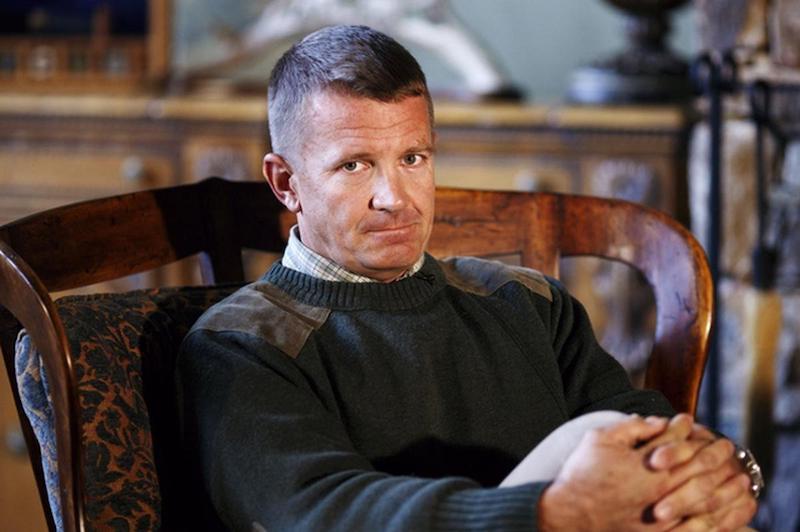
ERIK PRINCE, born in 1969, is an American entrepreneur and security expert. He is a former Navy SEAL and the founder and former CEO of the PMC company Blackwater USA, which he sold in 2010. He is the founder of the Frontier Group of Companies.
FRONTIER SERVICE GROUP online
SPARTANAT is the online magazine for Military News, Tactical Life, Gear & Reviews.
Send us your news: [email protected]
Ad
similar
Get the weekly SPARTANAT newsletter.
Your bonus: the free E-Book from SPARTANAT.
