Get the weekly SPARTANAT newsletter.
Your bonus: the free E-Book from SPARTANAT.


Lessons learned - US trainers in Ukraine
In Ukraine, US trainers are learning valuable lessons from Ukrainian soldiers experienced in conventional warfare. The article explores their insights and the differences in combat tactics, highlighting the need for US forces to adapt to new challenges.

Who comes to teach others can also learn a lot themselves. This is currently seen in Ukraine. In the western part of the country near Lviv, US trainers are working with Ukrainian soldiers - and they have to realize that these soldiers have more experience with conventional warfare than their advisers from the United States. The American military newspaper "Stars and Stripes" has spoken with US soldiers about their insights from Ukraine.
300 American paratroopers from the 173rd Airborne Brigade Combat Team are training Ukrainian National Guard soldiers in Yavoriv, who have allegedly fought against separatists in the east of the country, supported by the Russians. One of the American trainers openly admitted to Stars and Stripes that Americans have a lot to learn because after a decade of counterinsurgency operations against guerillas and insurgents in Iraq and Afghanistan, US soldiers no longer have experience facing a militarily highly professional and technologically equivalent enemy. "I have never been in a situation where I had to defend myself against drones," US Army Captain Zachary Savarie told the American soldier magazine, "I have also never been subjected to massive and accurate indirect fire." In comparison to their American trainers, the Ukrainian soldiers have much more experience in conventional warfare, which they have gained since the outbreak of the conflict in eastern Ukraine.
"We are facing Russian technology," says a Ukrainian officer, implying that "it is no secret in the east that the separatists are supported and supplied by the Russians." Every separatist force they encounter "is accompanied by Russian regulars - something they then call volunteers." However, Russia denies sending soldiers to fight in Ukraine and emphasizes that they have not provided material support to the separatists. Military experts, on the other hand, recognize classic elements of the Soviet military doctrine being applied, such as the concentration of troops along a wide front or the use of overwhelming, massive artillery fire. US soldiers are currently used to something quite different: the Taliban and insurgents in Iraq almost never attacked in large formations, and indirect fire, while annoying, was ultimately not a challenge.
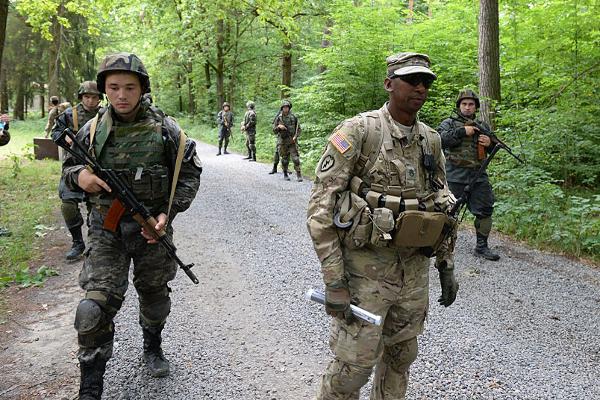 By contrast, the firepower of the separatists has surprised Western military analysts. In February, government troops suffered a heavy defeat when they had to abandon the fortified city of Debaltseve after fierce fighting. Massive artillery bombardment and repeated armored attacks were the cause, not low-profile tactics. During the withdrawal, the Ukrainian column was ambushed and decimated. This resulted in the loss of many soldiers' lives, and many more were captured.
A US general in the Pentagon promised to the press and talked about the "Russian drumfire" the Ukrainians were subjected to. Probably just a mistake.
Another trainer from the 173rd Airborne Brigade recounts that during his two deployments in the Hindu Kush in Afghanistan, he only saw US armored vehicles. This is not surprising. However, it indicates a growing lack of experience when it comes to fighting against armored forces. Yet, his Ukrainian students do not have this lack of experience: "A Ukrainian NCO told me how he was engaged in direct combat with a BMP armored vehicle at a distance of 15 meters, trying to shoot him. The Ukrainians fought back with anti-tank rockets at a distance of ten to fifteen meters. This is something we have taught our own people is absolutely unnecessary to train for because they would never end up in that situation." In other words, their own firepower is imagined to be so great that the enemy would have no chance of approaching so closely. The combat experience from Ukraine shows otherwise.
During their second rotation in Ukraine, the Americans have now adapted their curriculum to the students who are not novices but are experienced veterans. With the new "Basic Training" for the National Guard, there are now trainings on self-protection against drones. An expanded training for the Ukrainian army could also include exercises in electronic warfare, which primarily deal with Russian jamming methods, according to the agency.
All of this, of course, has a larger perspective: One day, US military forces could face an opponent who also applies the principles of Soviet tactics, says Olga Oliker, Director of the Center for Russia and Eurasia at the US think tank RAND Corporation. But the air superiority of US forces would likely make such a conflict look different than the current one in Ukraine. And the relationship between Russia and the USA, while tense, is far from having the possibility of an armed conflict. Another nice allusion, just like those of the Russians who have nothing to do with the conflict in Ukraine.
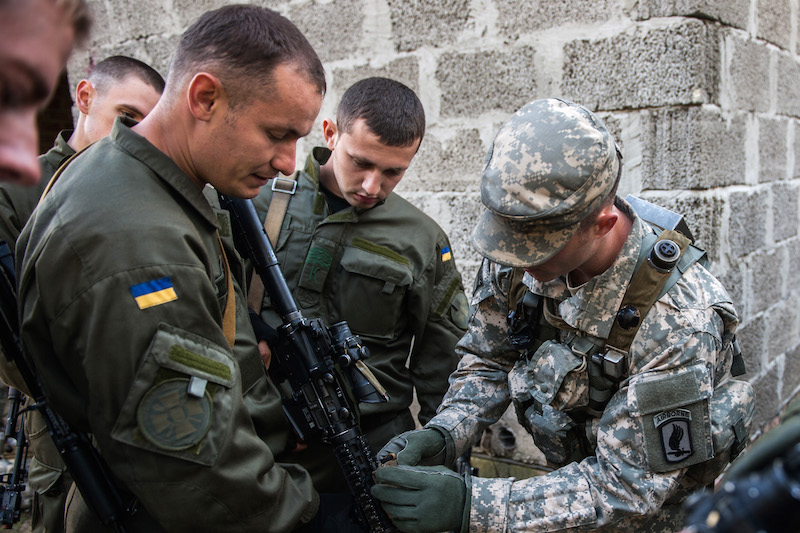
Ukrainian soldiers learning to use Western weapons.
SPARTANAT is the online magazine for Military News, Tactical Life, Gear & Reviews.
Send us your news: [email protected]
Ad
similar
Get the weekly SPARTANAT newsletter.
Your bonus: the free E-Book from SPARTANAT.
