Get the weekly SPARTANAT newsletter.
Your bonus: the free E-Book from SPARTANAT.

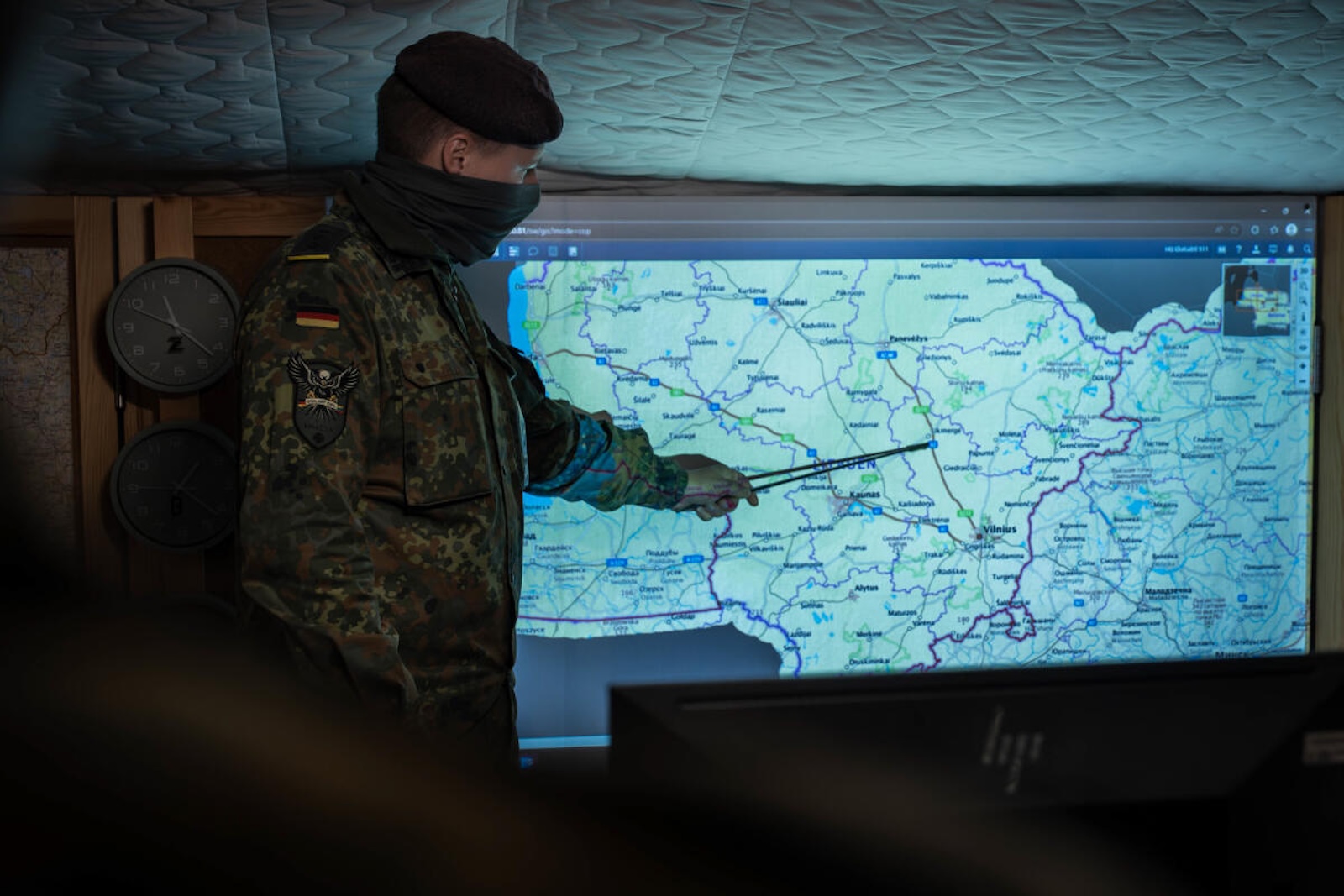
Ideas of War and Expectations of War
The 65th International Conference on Military History, hosted by ZMSBw and BAKS in Berlin from October 27–29, 2026, explores the evolving dynamics of warfare amid shifting global security landscapes. Featuring interdisciplinary panels, the conference addresses past and future war scenarios, hybrid warfare, and the implications for society and strategy.

From October 27–29, 2026, the ZMSBw, in cooperation with the Federal Academy for Security Policy (BAKS), will host its 65th International Conference on Military History (ITMG) in Berlin. Against the backdrop of a fundamentally changed global security landscape, this year’s conference is titled: “Images of War and Expectations of War: The Past and Imagined Futures of ‘Future War(fare)’.”
After the end of the Cold War, it quickly became clear that the hoped-for “peace dividend” had failed to materialize. This is evidenced by the failure of the United Nations in Somalia, the genocide in Rwanda that the international community failed to prevent, and the wars in the former Yugoslavia that spanned nearly the entire 1990s. While the violent conflicts of the 1990s bore the hallmarks of “new wars,” it has already become clear—with the Chechen wars, the war in Georgia, Russia’s annexation of Crimea and the Donbas, the invasion of Ukraine, and most recently the Armenian-Azerbaijani war—that state-to-state warfare rooted in power politics remains firmly on the global political agenda.
Diversity of Conflict Conduct
However, these conflicts are no longer waged solely by conventional means. Under the term “hybrid warfare,” there are numerous variants of attacks—some military, some non-kinetic—such as the manipulative and practical exploitation of policy areas like migration, the dissemination of narratives that threaten democracy without a factual basis, as well as sabotage attacks on civilian infrastructure and the civilian population, and even state-ordered assassinations of unpopular figures abroad. Finally, there is a resurgence of nuclear thinking, which, on the one hand, follows in the tradition of the Cold War, and on the other hand, serves as a threat scenario that is itself part of hybrid warfare.
Future Warfare
The predicted form of a possible future war—that is, the “war scenario”—is an expression of current expectations for the future. At the same time, war scenarios are based on past experiences. They often have a military-technical character and describe the assumed concrete realization of a future war (“Future Warfare”). Expectations in politics, the media, and society—as well as within professional communities—regarding which conflicts are at risk of escalating into war overlap in some respects with these conceptions of how a future war might unfold, while differing in others. The causes, triggers, and subjects of potential wars are at the center of expectations regarding war discussed in the media and in academic circles. Such discussions about “Future War” focus less on the actual combat and more on the implications for local, regional, or international constellations, states, and individuals.
The return of interstate war to Europe provides an opportunity to scrutinize, historicize, and shed light on current patterns of thought regarding war, warfare, and expectations of war. With ITMG 2026, the Bundeswehr Center for Military History and Social Sciences therefore adopts an interdisciplinary approach and a comparative perspective to address scholarly discussions on the war and warfare of the future.
Research Perspectives
Chronologically, the scope of the analysis will extend from the mid-19th century to the present;geographically, the focus will be on Europe, Asia, and North America, including theaters in the Far North, the deep sea, or outer space; disciplinarily, contributions are sought ranging from history to political and social sciences, as well as issues of technology and ethics, and a history of reception from film and literary studies.
Conference Program
1st Conference Day (October 27, 2026)
12:30 PM - 1:30 PM: Arrival and registration
1:30 PM - 1:50 PM: Welcome addresses Wolf-Jürgen Stahl, President, Federal Academy for Security Policy; Frank Hagemann, Commander, ZMSBw
1:50 PM - 2:15 PM: Introduction, Ina Kraft, ZMSBw
2:15 PM - 3:30 PM: Panel 1: Imagining War; Chair: Silvia-Lucretia Nicola, ZMSBw
Taming the Natives, Saving the Nation: The narrative construction of future climate wars in the French Army’s Red Team project; Eric Sangar, Sciences Po Lille
When and where will World War III begin, and will it be fought with nuclear weapons? Answers from Academia and Literature (When and Where Will World War III Begin—and Will It Be Fought with Nuclear Weapons?Answers from Academia and Literature); Armin Wagner, ZMSBw
3:30 PM – 4:15 PM: Coffee break
4:15 PM – 5:30 PM: Panel 2: Adaptation in the Military; Chair: Gerhard Kümmel, ZMSBw
From Air-Land Battle to Multi-Domain Operations: Concepts of Warfare Between Technological Dependence and the “Human Factor”; Frank Hagemann, Commander ZMSBw
When the Chameleon Fades: Friction, Shock, and the Struggle for Military Adaptation; Alexander Schäbler
5:30 PM – 6:30 PM: Optional dinner for participants (self-pay, advance registration required)
6:30 PM – 7:00 PM: Admission for the evening
7:00 PM – 9:00 PM: Research on the Military in Times of Democratic Erosion: Authors, Editors, and Academic Freedom (Discussion Panel in German)
Expert Introduction & Moderator: Janika Spannagel, FU Berlin & SCRIPTS Project “Science Friction: Patterns, Causes, and Effects of Academic Freedom Contestations”
Panelists:
Christoph Harig, Scandinavian Journal of Military Studies
Albrecht von Lucke, Blätter für deutsche und internationale Politik
Manfred Sapper, Zeitschrift Osteuropa
Followed by a reception (complimentary drinks)
Day 2 of the Conference (October 28, 2026)
9:30 AM – 10:30 AM: Panel 3: Forming Strategy in the Military; Chair: Martin Elbe, ZMSBw
Deja-HU. NATO’s Response to the Russian Invasion of Hungary (1956) & Ukraine (2022)
Christopher L. Gunn, Coastal Carolina University
Between Wishful Thinking and Strategic Imperative: The Struggle for Dominance over the Narrative and Interpretation of Warfare within the Federal Ministry of Defense in the Early 1990s
Martin Reese, ZMSBw
10:30 AM - 11:00 AM: Coffee break
11:00 AM - 12:30 PM: Panel 4: Concepts of War; Chair: Johann Schmid, ZMSBw
From Conquest to Containment: Evolving Concepts of War on the Afghan Frontier, 1850–1940;
Arka Chowdhury, Sri Ramkrishna Sarada Vidya Mahapitha
Future War and Next War: Perceptions of Modern Warfare in Latvia, 1920s–1930s; Karlis Dambitis, National Defense Academy of Latvia
War without Warfare: China’s Gray-Zone Strategy and the Redefinition of Conflict; Christopher K. Tong, University of Maryland
12:30 PM – 2:00 PM: Lunch break
2:00 PM – 3:30 PM: Panel 5: Laboratories of War (I): Germany and Great Britain from World War I to the 1930s; Chair:Friederike Hartung, ZMSBw
Fuller’s “Plan 1919” – The Vision of Revolutionary Warfare; Karsten Richter, German War Graves Commission
Avoidance vs. Optimization—Total War in Conceptions of the “War of the Future” within the Reichsheer Leadership (1920–1926); Christian Stachelbeck, ZMSBw
War: A Whole-of-Society Affair—On the Demilitarization of the “War of the Future” and Its Civilian Appropriation in the 1920s and 1930s; Frank Reichherzer, ZMSBw
3:30 PM – 6:00 PM: Guided tours of Schönhausen Palace (advance registration required) and an opportunity for dinner (optional, self-pay, advance registration required)
6:00 PM – 7:00 PM: Admission to the evening event
7:00 PM - 9:00 PM: The Use and (f)Utility of Imagining Future War
Keynote Address and discussion (in English)
Tim Sweijs, Hague Centre for Strategic Studies
Moderator: Alaric Searle, ZMSBw
Followed by a reception (complimentary drinks)
3rd Conference Day (October 29, 2026)
9:30 AM - 11:00 AM: Panel 6: Laboratories of War (II): The American Military Century; Chair: Heiner Bröckermann, ZMSBw
Preparing for What War? The U.S. Army in a Time of Transition, 1919–1939; Alexander Reineke, Ruhr University Bochum
“A Marvelous Excuse”: General William DePuy, Interwar Escapism, and Concepts of War in the U.S. Army, 1973–1976; Eric Michael Burke, Stahnsdorf (formerly U.S. Army)
Continuity in a Changing Security Environment: U.S. Armed Forces Planning, 2001–2014; Philipp Münch, ZMSBw
11:00 AM – 11:15 AM: Coffee break
11:15 AM – 12:15 PM: Panel 7: Legacies of War; Chair: Jörg Echternkamp, ZMSBw
SPARTANAT is the online magazine for Military News, Tactical Life, Gear & Reviews.
Send us your news: [email protected]
Ad
similar
Get the weekly SPARTANAT newsletter.
Your bonus: the free E-Book from SPARTANAT.
