Get the weekly SPARTANAT newsletter.
Your bonus: the free E-Book from SPARTANAT.

I save myself (2) - prevention, self-assertion & self-defense
This text provides insights on prevention, self-assertion, self-defense, and techniques for personal protection against physical or psychological attacks. It emphasizes the importance of prevention, early detection of dangers, and self-confident behavior, especially for women and children. The author, Markus Schimpl, draws on his extensive experience in the security sector. It also discusses the definitions of perpetrators, victims, and techniques. The text highlights the significance of preventive behavior for children and the role of self-help in dangerous situations.

As a security expert and non-fiction author, Markus Schimpl has been gaining experience in the state and civil security sector since 1991. Especially as a security advisor and personal protection expert, he can draw on extensive national and international operational and professional experience. With ICH RETTE MICH, he has presented a standard work on self-protection. Today we are bringing you an excerpt on the topic of prevention, self-assertion, and self-defense. Let's start with definitions:
Definition: Prevention
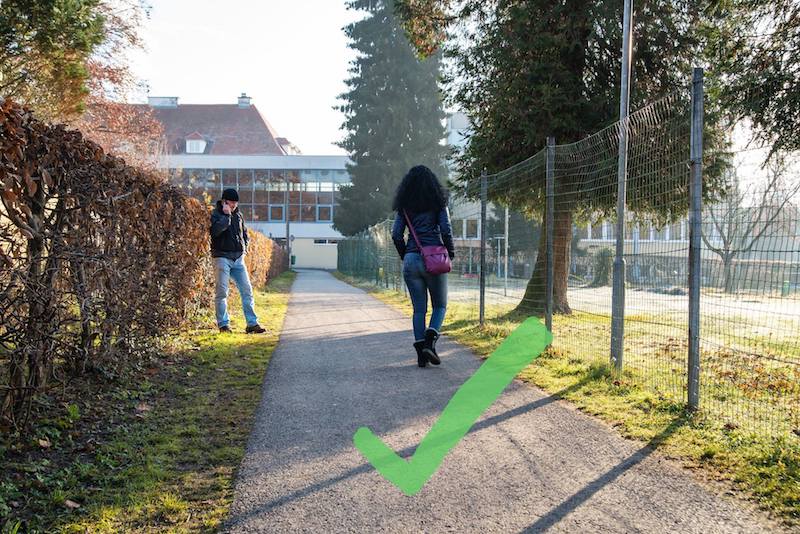
"Prevention is the term for measures to avert or reduce undesired events or conditions that can occur with a certain probability." Prevention is mainly characterized by the early detection of dangers and the right actions to be able to avoid possible risks in time. It is very important to raise awareness among women, young people, and children on the mentioned topics. The potential dangers are often underestimated but should be clearly emphasized. Self-defense or self-assertion courses should primarily convey self-confident behavior.
Distance is safety. Self-defense is the last possible step in self-protection. (Staged image).
Definition: Self-Assertion
“Self-assertion is the ability to be aware of one's own boundaries in transboundary situations and to be able to make them clear. The use of self-assertion techniques, self-confident behavior, and early recognition of dangerous situations are necessary to avoid the use of physical defense techniques.” Self-assertion is also characterized by appropriate behavior, mostly in the form of an upright and self-confident posture (non-verbal signal).
Definition: Self-Defense
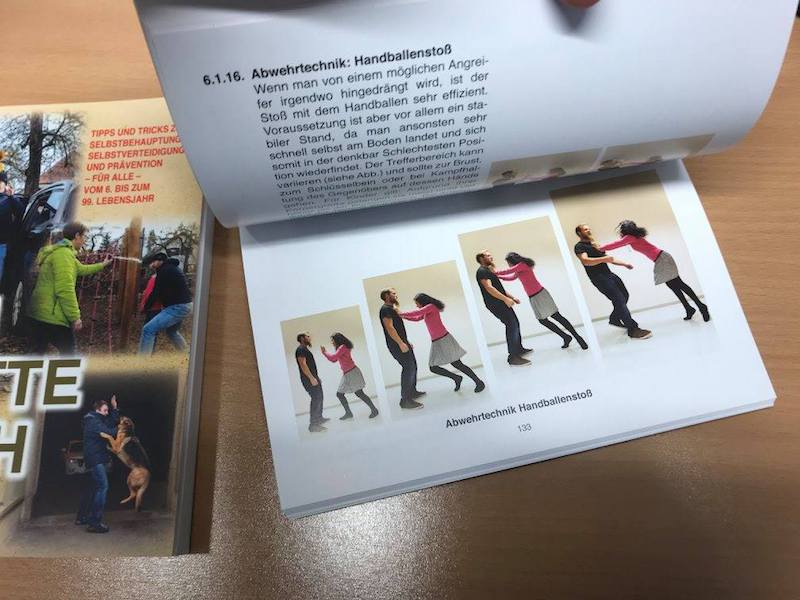
Self-defense refers to the prevention and defense against attacks on the psychological or physical integrity of a person. Self-defense should be characterized by quick action and the use of the element of surprise.
In self-defense, two reactions can be triggered: one would be to counteract an attack or assault with almost superhuman strength, the other is freezing out of fear. Through practical, action-oriented, and repeated training, the probability of freezing out of fear is attempted to be minimized. However, this requires constant training, similar to first aid training. After too long of a non-use of first aid techniques and respective self-defense techniques, effective implementation in a real situation will be difficult or even impossible.
Definition: Perpetrator
In legal language, a perpetrator is defined as someone who commits an illegal act.
Perpetrators can generally be divided into four categories:
1. Perpetrators who act based on uncontrollable drives and impulses.
2. Perpetrators who act due to mental illness, psychopathy, or sociopathy.
3. Perpetrators who temporarily lose control due to alcohol, drug use, etc.
4. Perpetrators who have acted in response to "victim instigation."
Definition: Victim
A victim is someone who suffers physical and/or emotional harm from an attack or assault. Those who become victims of a crime often struggle with the consequences for a long time. Physical injuries, as well as psychological problems such as post-traumatic stress disorders, can severely affect the victims.
Definition: Technique & Automation
Technique is an ideal image of a movement sequence based on scientific knowledge, theoretical considerations, and practical experience, in which the performer tries to strive for the coordination of inner and outer forces. In the courses I hold, the focus is not on the optimal execution of a technique but on the implementation of a fragment of a shown and practiced technique that is individually adapted by each course participant to their skills, but is still so effective and efficient to ward off an attack. That is why one of my maxims is "A technique is good when it works, no matter how it looks." Only the simplicity of a technique is effective! The more technique, complexity, or inner calm a technique requires, the lower the probability that it will work in a real attack. Ruthless determination usually triumphs over technique.
Automation: A movement sequence is considered automated when it runs as if by itself, automatically and unconsciously, so that one can focus on other things. It takes about 20,000 to 40,000 repetitions for a technique to run automatically. Therefore, a military-style drill training should be aimed at automating a technique. Based on my years of experience in training, the following realization has been confirmed: "Once you have achieved automation of a technique or skill, it unfortunately usually only lasts a few weeks to at most a few months without refresher training."
Who helps me if I have a problem?
Basically, one cannot assume that there is a person nearby when in danger. Furthermore, one cannot expect a randomly present stranger to intervene and help. Therefore, in truth, there is only one person who makes decisions and can help me, and that is myself.
Sexual Assault and Attacks
Many girls and women of all ages have been subjected to attacks or threats. These range from "simple" harassment to rape. Important factors here are the development of a healthy self-esteem, coping with fear, a certain sense of security, and a piece of quality of life. Many women limit themselves in their living environment due to the lack of these factors. In addition, official resistance against sexual assaults and abuse is now desired and supported by the criminal police. The previously common opinion: Resistance escalates violence is no longer valid in this form.
Resistance in the face of sexual assault and attacks should always take place!
Especially important are:
a. Confident behavior
b. Stable stance
c. Preventive behavior
Preventive Behavior
"The fight that does not happen is the best fight!" (Shaolin) The term "prevention" is derived from the Latin verb "praevenire," which means "to prevent" or "to preempt an event." In the field of criminology, the term "crime prevention" refers to the totality of all preventive measures aimed at avoiding the commission of future crimes. The classic concept of crime prevention refers to criminal law and criminal law enforcement. This means generally securing the legal consciousness of the population by sanctioning an act. However, a new "extended" concept of crime prevention has also emerged, which refers to society as a whole, i.e., the application of all prevention strategies (self-defense courses, ...).
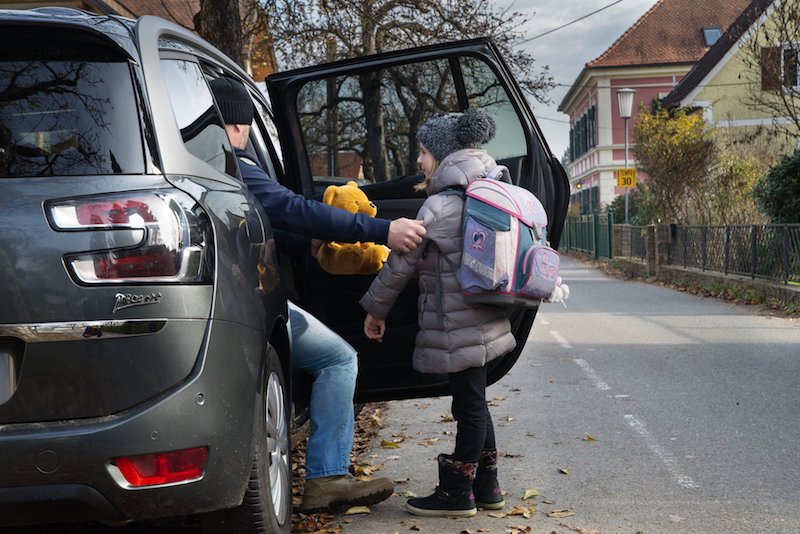
Distance is safety. The first step is to learn not to get too close to strangers. (Staged image).
Why is preventive behavior especially important for children?
If a child is unable to recognize the danger posed by an attacker, it may end up in a situation from which it cannot free itself. A child is physically weaker than an adult! Even if this child does not put itself in the "victim role," it is still in a "victim status." The reality is that the physically stronger person is always superior to the physically weaker one!
Here is an example from one of the courses conducted:
In one of my self-assertion courses at an elementary school, we had the pleasure of practicing with the regional kickboxing champion. This young boy, at the time ten years old (4th grade), thought he could easily defend himself against the course instructor based on his martial arts techniques. The instructor briefly held him and the boy could not free himself for the duration of the grip (about 15 seconds)!
If the child learns to behave preventively, it helps:
• Immediately recognize possible dangers.
• Keep distance and assume an inner defensive stance immediately.
• Not to be taken by surprise unknowingly.
Prevention does not start with warning about the "evil." The word "evil" is fear-laden. The aim is not to scare children but to take away their fear by empowering them.
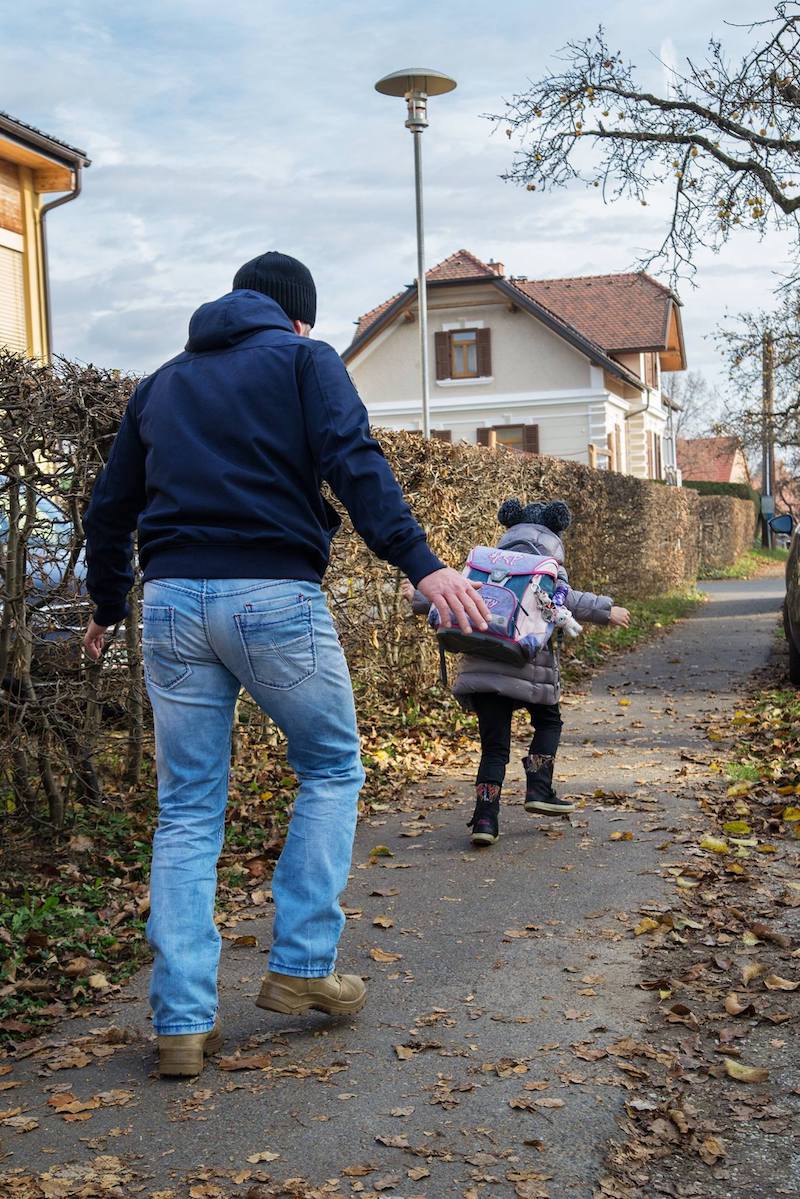
Distance is safety. Running away is self-protection. (Staged image).
Gut Feeling is Good
When children are asked where they feel their fear, they point to their stomach and call it "gut feeling." Fear has a lot to do with trust, both in oneself and in life. In nature, fear only arises in dangerous situations (natural disasters, natural enemies). But civilization brings about additional dangers that are not provided by nature (war, threat of humans by other humans). Initially, children are "hypnotized" by fear just like many adults. They cry and run to their parents to seek protection. The powerless reaction arises from the wrong handling of it. Fear is a natural protective function; it arises and warns us. Fear makes one very alert and directs perception towards the threat. Thus, the perception is maintained, and children are reactive and capable of action. After overcoming the situation, the fear disappears because it has successfully preserved and protected us. Special attention is paid to ensuring that each child knows at least one telephone number of a trusted person by heart, so that in an emergency, they can ask an adult for help and call someone to pick them up.
HERE is the first part: ICH RETTE MICH - Instructions for Self-Protection
“Ich rette mich - Tips and Tricks for Self-Defense, Self-Assertion, and Prevention for All Ages 6 and Up to 99
CLOSE PROTECTION on the Internet: www.ichrettemich.com
SPARTANAT is the online magazine for Military News, Tactical Life, Gear & Reviews.
Send us your news: [email protected]
Ad
similar
Get the weekly SPARTANAT newsletter.
Your bonus: the free E-Book from SPARTANAT.
