Get the weekly SPARTANAT newsletter.
Your bonus: the free E-Book from SPARTANAT.

Golden Hour Under Scrutiny
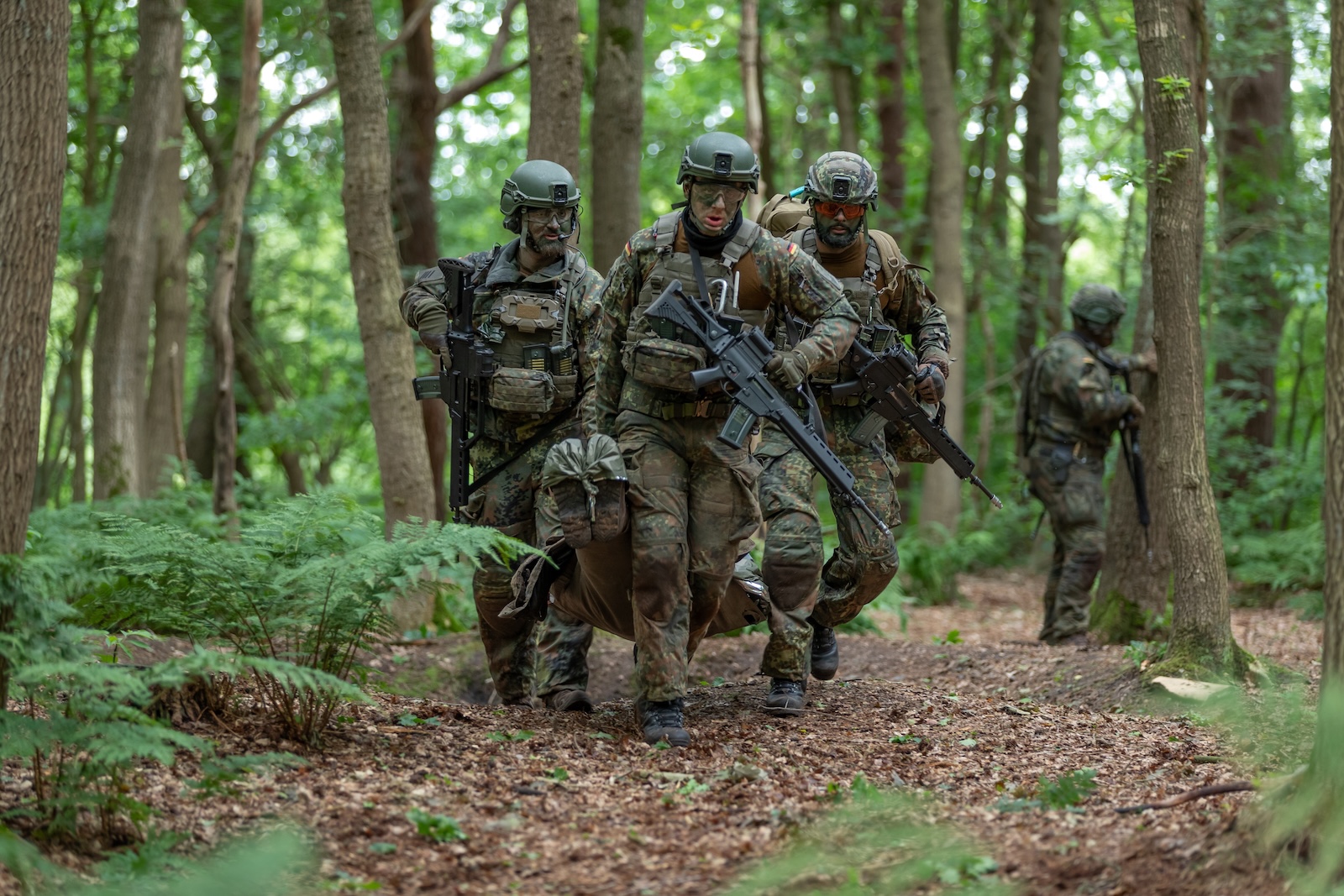
Russia's war in Ukraine highlights the severe impact of psychological warfare on medical care, with deliberate attacks on medical facilities jeopardizing the Golden Hour principle of timely treatment. Tactical considerations shape medical responses, emphasizing the need for resources and flexibility in conflict zones, including innovations like drone transport for blood products.

Russia’s war of aggression in Ukraine clearly demonstrates that Russia is also exerting a massive impact through psychological warfare. Protective symbols such as the Red Cross are no longer respected. Medical facilities and vehicles are being deliberately targeted, meaning that wounded soldiers often cannot be evacuated from the front lines for days.
The concept of the “golden hour” has been a focus of the Bundeswehr Medical Service for at least 20 years. Medical care in wartime is tailored to the specific challenges of military scenarios, which always involve different conditions than those in peacetime. Even in peacetime, however, natural disasters or accidents can occur that require disaster medicine. Military medicine is therefore always an integral part of disaster medicine. “The attack on Breitscheidplatz clearly demonstrated that even in times of complete peace, we must be capable of providing medical care beyond major accidents or natural disasters to enable as many people as possible to survive with the highest possible degree of rehabilitation,” explains the commander of the Bundeswehr Medical Command, General Staff Physician Dr. Johannes Backus. And this must also apply on the military battlefield.
The Golden Hour is Based on Physiology
Ultimately, the Golden Hour is nothing more than a principle of care. It describes the physiological processes that occur at defined intervals following damage to the biological system—that is, the human body. If no medical countermeasures are initiated within these time windows, irreversible pathophysiological conditions develop. In the worst-case scenario, these lead to death, even if the patient can still be transported alive to a medical facility. In this respect, the Golden Hour always raises the question of whether the necessary conditions are in place to transport an injured person to a suitable medical facility as quickly as possible. The best possible care is generally provided in hospitals, as they have the most comprehensive medical treatment options. Patients with a heart attack are made transportable on-site by the emergency physician just as those involved in a traffic accident are. All are transported to the hospital. In military medicine, this is fundamentally no different.
Framework conditions are crucial
“The soldier’s working environment is the battlefield,” says Dr. Johannes Backus. If physical injury occurs there, the question arises as to the options available for stabilizing the wounded person for transport to the hospital, explains the physician. This is not always possible in war. The Golden Hour is a principle of care. If the framework conditions—such as air superiority, combat superiority, and resource superiority—are in place, the Golden Hour can be applied. If these conditions are not met, other principles of care must inevitably be applied. However, all principles of care fundamentally aim to stabilize the patient.
Focus on Tactical Casualty Care
In tactical casualty care, experience from Ukraine shows that it is always necessary to weigh how care should be provided under various tactical conditions. These considerations aim to achieve the best possible survival with the least possible physical damage. Military physicians advise military leadership on the military-medical implications of tactical decisions. “Ultimately, it always comes down to weighing what takes precedence,” explains the Chief Medical Officer. So if the circumstances do not allow for an ideal rescue chain with air rescue assets and closely spaced medical facilities, the goal remains to establish the most stable possible ground-based rescue chain with the best possible medical care in the region. A wartime scenario involving national and alliance defense would inevitably result in higher failure rates than peacekeeping missions such as those in Afghanistan, Mali, or Kosovo, says Dr. Backus.
Moral Warfare in Ukraine
The situation in Ukraine is currently characterized by the fact that the deployment of rescue assets is significantly hampered by drone operations and the Russian army’s air superiority. What is particularly insidious is that moral warfare is also being used as a weapon. The Russian armed forces are explicitly targeting medical facilities, regardless of whether they are used for civilian or military purposes. They are shelling hospitals and medical facilities and deliberately sending drones against medical facilities and ambulances. As a first step, the Ukrainians have begun to camouflage these facilities. It is no longer possible to tell whether a vehicle or facility is medical. As a second step, treatment facilities were established within permanent infrastructure and, where possible, underground. As a third step, patient transport was restricted to after dark. This means that the Golden Hour cannot be applied in every situation, as it depends on specific conditions. “Qualified medical personnel must therefore be brought to the front lines to ensure ‘prolonged field care’—that is, extended care in the field—until the point at which transporting the wounded becomes possible,” explains General Staff Surgeon Dr. Backus. But even prolonged field care is merely a principle of care and depends on certain conditions. Ultimately, it comes down to being able to act flexibly. And that is always a question of resources as well.
Supply of Blood Products
A major lesson from the wars in Ukraine and Gaza is that the supply of blood and blood products at the front is crucial for the survival of wounded soldiers. In cases of injuries involving significant blood loss, it is extremely important to prevent hypovolemic shock. However, blood and blood products are subject to strict regulations regarding transport and storage. Therefore, the focus is shifting back toward whole blood transfusion. “Whole blood transfusion significantly saves lives in war!” Dr. Backus is convinced. The Chief Medical Officer knows this is a “game-changer” for improving survival on the battlefield following a potentially life-threatening injury. To deliver both blood products and necessary medical supplies to the battlefield, the Medical Service has been working on various solutions for the past two years. One of these is transport via drone, both for supplies to the front lines and for wounded personnel from the front lines.
SPARTANAT is the online magazine for Military News, Tactical Life, Gear & Reviews.
Send us your news: [email protected]
Ad
similar
Get the weekly SPARTANAT newsletter.
Your bonus: the free E-Book from SPARTANAT.
