Get the weekly SPARTANAT newsletter.
Your bonus: the free E-Book from SPARTANAT.

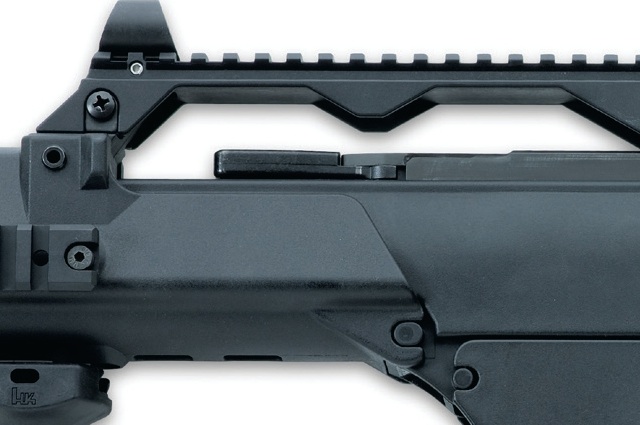
G36 - a defamation
AP: Media professionals are regurgitating a familiar headline about the accuracy of the G36 assault rifle, criticizing Heckler & Koch. Contrary to sensational claims, the G36 meets Bundeswehr's requirements. The rifle, designed in 1996, has evolved with technological advancements, outperforming NATO counterparts. However, Minister von der Leyen's premature report has damaged trust in the company. Accusations lack substance, raising questions about the motives behind the defamation campaign. Heckler & Koch's press releases shed light on the situation, but media remains indifferent. The targeted attacks not only harm the reputation of Heckler & Koch but also undermine the German technology sector.

Whether it is due to the already headline-free time around the Easter holidays, or the restrained spring weather that has not yet fully managed to uplift the spirits of the media professionals, but currently a number of even nationally established media platforms are actually trying to bridge the continuously recurring media gap again with a headline that has been rehashed dozens of times in recent years. At regular intervals, the verbal straw fire "the assault rifle G36 is not accurate" is reignited and inflated into a pseudo-scandal. The actual scandal is not the headline itself, but the blanket and unfounded defamation of the Oberndorf company Heckler & Koch.
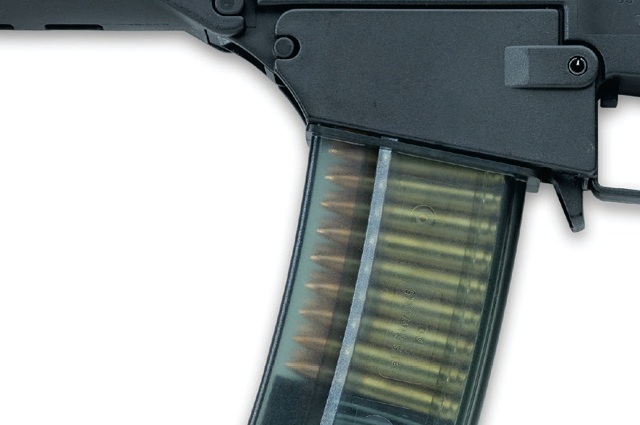 The reporting is hardly about the alleged "inadequate accuracy of all 176,000 rifles of the G36 family", but about a comprehensive campaign based on the principle of "a constant dripping wears away a stone." The generalized accusations and sensational headlines quickly give unsuspecting readers the impression that in the German defense industry, projects are either watered down or delayed out of incompetence or, worse, calculation. Heckler & Koch has responded to these accusations and subjected a selection of weapons from different lots to the described conditions in an extensive series of tests. The Bundeswehr-defined EBC (Combat-proximity firing cycle) test involves a tactical "worst case" scenario in which the soldier fires his entire daily supply of 150 rounds from his G36 in less than 20 minutes. However, when formulating their requirements in 1992, the Bundeswehr did not intend the weapon for this then already atypical "combat style". Nevertheless, the result: all requirements and performance parameters demanded by the Bundeswehr have been fully met. File can be accessed as a PDF on the H&K website.
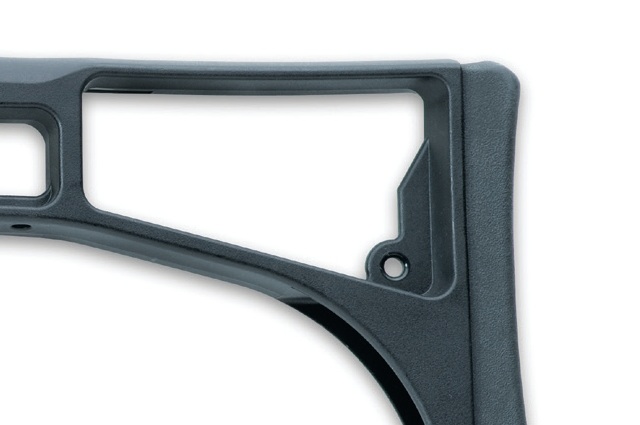 Nevertheless, THE PRESS IS RIGHT OVERALL!!! The currently used G36 assault rifle by the Bundeswehr and many other NATO armies is not up to date with the latest in technology. Because the G36 project is clearly a product of its time.
This time was 1996. As a successor model to the proven G3, the G36 was tailored to the NATO doctrine of combined arms combat in the power struggle between the USA and the USSR at that time. Here, the performance of the individual shooter was not decisive, but the overall combat power of large units.
Foreign deployments like the Balkan conflict from 1999 IFOR/SFOR/KFOR or from 2002 ISAF were not foreseeable for Bundeswehr soldiers at that time. Accordingly, there were no changed requirements for the equipment or armament of the infantry, or to the German defense industry. Over the 15 following years, the G36 has been gradually technologically aligned with the new requirements within the defense budget. Various add-ons and modifications, as well as new materials, significantly increased the functionality and safe handling of the weapon. The quality of the optical sighting devices was significantly increased, allowing the first hit probability to be multiplied. So, the aging concept of the G36 is currently at its most modern state and is even superior to all comparative models of other NATO partners such as the Colt M16/M4, Enfield L85, FAMAS, and even the Russian AK 74. However, what happens with weapon systems that have far exceeded their intended service life can be traced with the medium transport helicopter CH-53 G(S) and the tactical transport aircraft C-160 Transall. Numerous other examples could follow here.
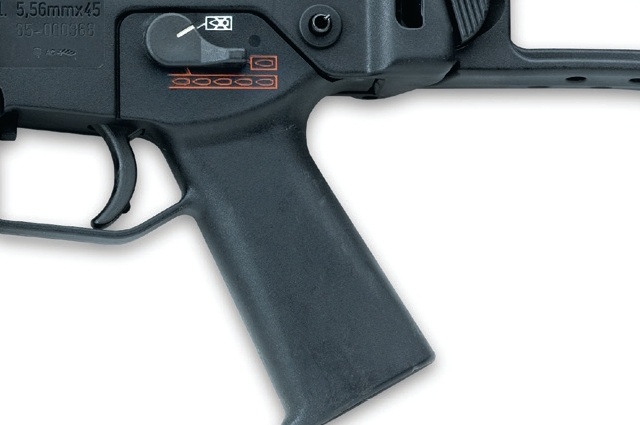 Heckler & Koch, as a globally renowned company for infantry weapons, was already a visionary pioneer for the most advanced firearms technology with its groundbreaking G11 project in 1968. Dynamit Nobel manufactured the caseless ammunition at that time. After numerous shooting and field tests, the Bundeswehr certified in 1990 the suitability of the weapon system. Even the US Department of Defense and other nations had great interest in adopting this technology. A concept like the "Swiss Army knife" weapon as the "Assault Rifle of the Future" was technically possible, but was no longer desired by the politics at that time. The financing of the reunification with the GDR had received higher priority. As a plan B for modern infantry armament, a cheaper transitional model, the HK 50 (G36), was then pulled from the drawer at Heckler & Koch in 1992.
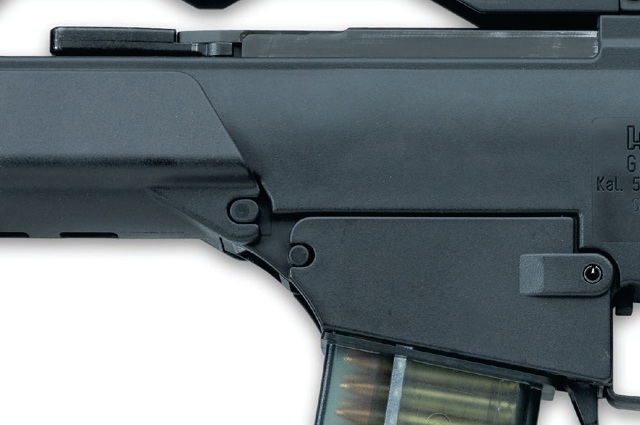 The current actions of Minister von der Leyen with the premature negative report on the G36 have understandably caused resentment at H&K and certainly resulted in a massive breach of trust. The management rightfully criticized the lack of sensitivity in the face of accusations of this kind, pointing out that a careless word could have far-reaching consequences for the company. Strangely, there was also no clarification discussion or joint test series proposed by the BMVg in advance to demonstrate the safety of the weapon.
Heckler & Koch in several press releases (last updated April 10, 2015) and in their own test series, they highlight the discrepancies in the requirements. However, almost all media representatives inexplicably ignored these enlightening explanations and maintained their blockade strategy.
If the accusations about the technology of the weapons miss the mark and are thus void, the core question remains: "Qui bono," that is, who benefits? Who ultimately benefits from such a complex defamation campaign against the company Heckler & Koch? Not the soldiers, not the technology location Germany, and not the quality label "Made in Germany".
Udo Lücken
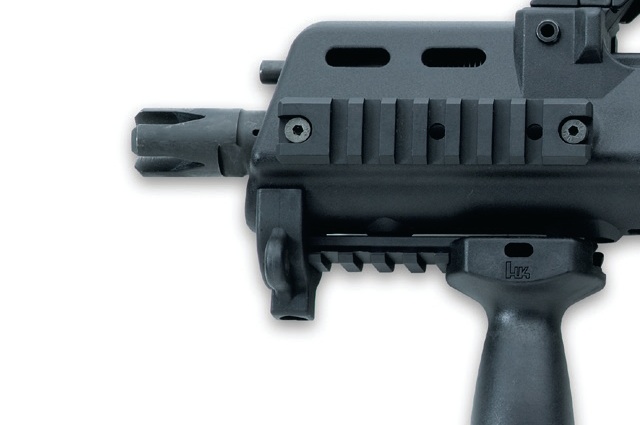 Heckler & Koch on the Internet: www.heckler-koch.com
SPARTANAT is the online magazine for Military News, Tactical Life, Gear & Reviews.
Send us your news: [email protected]
Ad
similar
Get the weekly SPARTANAT newsletter.
Your bonus: the free E-Book from SPARTANAT.
