Get the weekly SPARTANAT newsletter.
Your bonus: the free E-Book from SPARTANAT.

No Photography – Then Everything Online
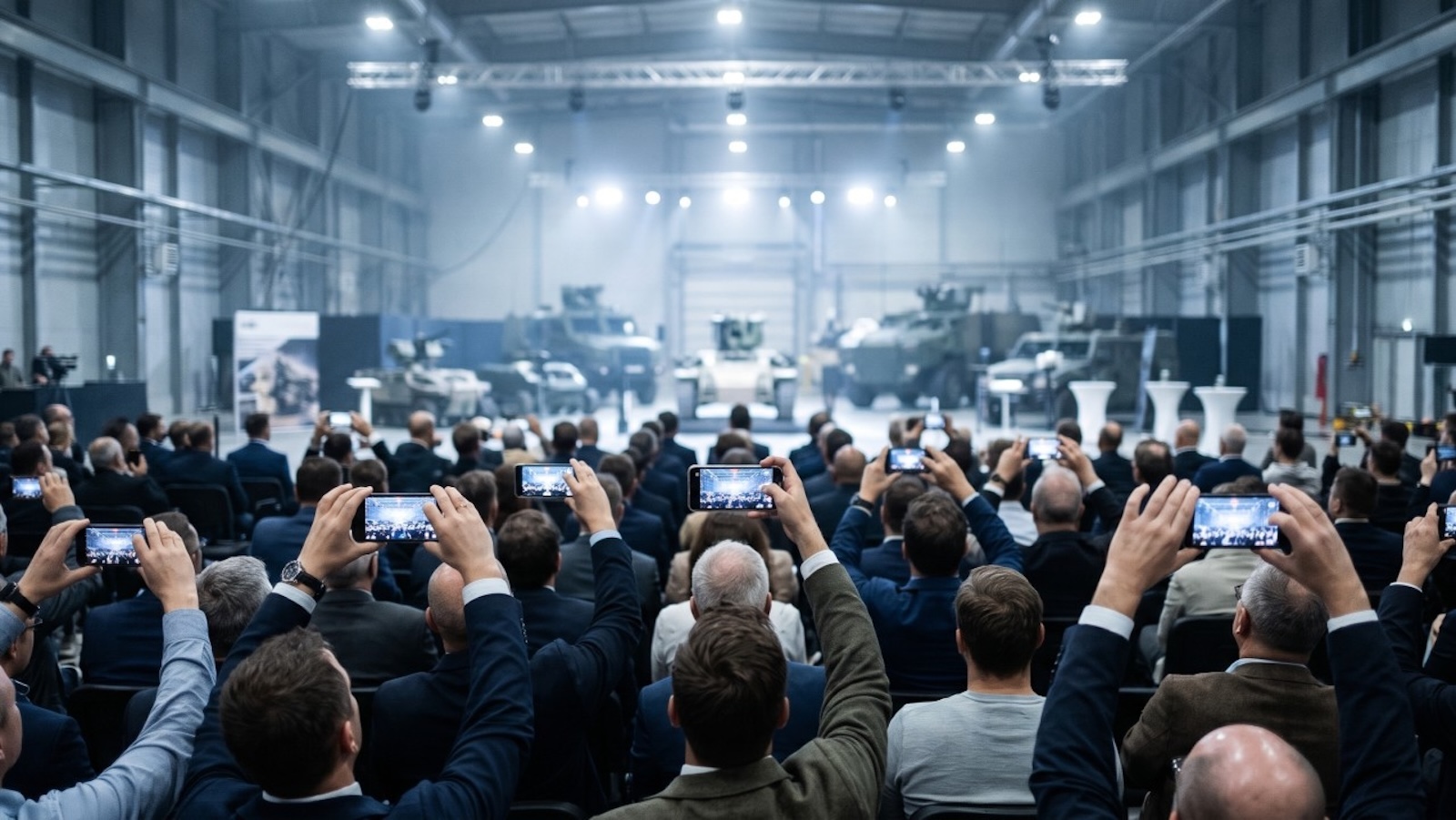
On October 22, 2026, the Defense TechDay at Erding Air Base faced violations of a ban on photography despite stringent security protocols. The event highlighted the risks of sharing sensitive information online, emphasizing the need for a more robust security culture within the defense industry to prevent potential espionage and compromise.

No joke—but I have to vent a little and throw a wrench in the works here… On October 22, SPARTANAT author Jan Hesselbarth attended the Defense TechDay 2026 at Erding Air Base—organized by Bayern Innovativ GmbH. The ban on filming and photography was stated in advance in the participant email and reiterated on-site. Throughout the day, however, I still saw dozens of cell phones in the air, and by evening, a stream of photos was already circulating on LinkedIn. In doing so, we’re providing material that none of us would hand over to a foreign intelligence service if asked.
What Happened in Erding
Defence TechDay 2026 took place on October 22, 2026, at Erding Air Base, hosted by Bayern Innovativ GmbH through the Security Innovation Network. Attendance was by invitation only; the registration deadline was October 15, and late registrations were not permitted. Invited were decision-makers from the Federal Ministry of Defense (BMVg) and the Bundeswehr, from security agencies, the Federal Intelligence Service (BND), the Federal Criminal Police Office (BKA), and state police forces, as well as representatives from the defense industry.
The content got right to the point. Three live scenarios demonstrated strategic reconnaissance from orbit using AI-supported data fusion, the protection of mobile forces against drones and GNSS spoofing, and autonomous point defense of critical infrastructure. Participants included, among others, Rheinmetall, HENSOLDT, Diehl Defence, Airbus Defence and Space, Quantum Systems, ARX Robotics, Rohde & Schwarz, OHB SE, constellr, LiveEO, WINGCOPTER, THYRA, MBDA, Autonomous Teaming, STARK, and numerous others. The event also featured the opening of the Defense Lab Erding and an accompanying exhibition with static displays.
All in all, this represents a cross-section of what German defense innovation is currently capable of. That is precisely why the day was so valuable for those in attendance. And that is precisely why it is so interesting to others.
What I observed
The public event page contains no information regarding restrictions on recording. The prohibition was communicated to participants and reiterated on-site. It was clearly worded, it was understandable, and it was justified.
Hardly anyone adhered to it. During the live scenarios, phones were held aloft; at the static displays, people filmed from close range; and during breaks, photos were taken. More striking than the behavior itself was the reaction to it: there was none. No one spoke up. Myself included—or at least less often than I now realize I should have. That evening and over the next two days, the photos circulated on LinkedIn, tagged with names, companies, job titles, and a line expressing enthusiasm.
I understand the impulse. You’re standing in front of an autonomous system that was just a slide two years ago, and you want to share it. The industry is growing, visibility helps secure contracts, and a good photo from a good day is a powerful marketing tool. The impulse is human. The consequences are not.
How Harmless Photos Become a Snapshot of the Situation
A single photo rarely reveals anything that the other side wouldn’t already know. The impact arises from aggregation, and it happens without any action on the part of the person uploading the photo.
From a collection of participant photos taken in a closed format, it’s easy to deduce: which systems actually exist at what level of maturity—rather than just on data sheets; which sensors, antenna configurations, and interfaces are installed; which companies are standing together on stage and are therefore presumably working in a consortium; which representatives from which government agencies were present and with whom they spoke; how the site is laid out, where the entrances are located, and how far the barriers extend. Added to this is what’s visible in the background: name tags, open laptops, presentation slides, and license plates.
The benefit for an adversary lies on two levels. The first is technical: a photo of an effector next to a person provides scale, construction details, and the level of integration—and thus clues for countermeasures. The second is personnel-related, and it is underestimated in our industry. Anyone who knows from public posts that Mr. X from Company Y was the head of development in Erding has a qualified target—complete with a conversation starter for initiating contact. The Federal Office for the Protection of the Constitution (BfV) has been warning for years about precisely this pattern involving career networks, documented in particular for Chinese intelligence services that establish contact through fake consultant profiles.
The BfV explicitly updated this warning for our industry in July 2026. The Security Advisory for the Business Sector 02/2026 is titled “The Security and Defense Industry as a Target” and assesses the threat level as high, with a particular focus on companies with ties to Ukraine or the technology sector. Two of the recommendations are to exercise caution when sharing details about tasks, projects, and locations on social media and career platforms, and to review posts in advance for security risks. This is not a theoretical concept from a policy paper; it is an official recommendation for action that was sent to the chambers in July and which, four weeks later in Erding, was clearly not being followed by anyone.
The Legal Framework
A ban on entry to an air force base is primarily based on the operator’s right to manage the premises and on the terms of participation. A violation constitutes a breach of contract, resulting in expulsion from the premises and a future ban on entry.
In addition, there is a criminal provision that is rarely invoked in this sector. Under Section 109g(1) of the German Criminal Code (StGB), anyone who takes or disseminates images of weapons, military facilities or installations, or military operations, thereby knowingly endangering the security of the Federal Republic of Germany or the combat effectiveness of the armed forces, is liable to prosecution. The penalty ranges up to five years’ imprisonment. Paragraph 4 covers the same conduct in cases of intentional or reckless endangerment, with a penalty of up to two years, and clarifies that actions taken with the permission of the competent authority remain exempt from punishment.
For context—and this is expressly not legal advice: The threshold of “knowingly endangering” is high; the average user’s reflex to post content will generally not meet it. However, the provision shows where the legislature has drawn the line, and the “recklessness” provision in paragraph 4 is closer to everyday reality than many realize. Whether the elements of a crime are met in a specific case remains a matter for case-by-case review. The fact that an accredited photographer with authorization is different from three hundred cell phones without authorization is already evident from the requirement for authorization in the same provision.
The Threat Situation in Numbers
The figures currently available come primarily from reports on official situation assessments and are therefore secondhand. I point this out because the primary sources have not been published.
On October 20, 2026, CORRECTIV analyzed internal documents from the Joint Defense Center for Hybrid Threats (GAZH), which opened in June 2026. For the year 2026 up to the cutoff date of August 19, the BKA situation report cited there lists 163 suspected cases of sabotage, 1,034 drone overflights of critical infrastructure, military facilities, and defense contractors, as well as 25 espionage investigations, 13 of which were in the cyber domain. The figures refer to different time periods; no methodology for counting suspected cases is provided, and the documents themselves are not public. As an indication of scale, they are reliable enough; as statistics, they are not.
Additionally: In August 2026, a spokesperson for the Operational Command told the Redaktions Netzwerk Deutschland that there had been “several hundred” suspected drone overflights in the Bundeswehr’s area of responsibility since the start of Russia’s war of aggression. On the night of August 6–7, 2026, at least six suspicious overflights were recorded over the Bleiberg Barracks in Mechernich.
So someone is investing considerable resources to obtain footage of our properties and facilities. We produce the same material for free and post it online under our real names.
What this costs in an emergency
On January 1, 2023, a Ukrainian attack struck a Russian barracks in Makiyivka. On January 4, 2023, the Russian Ministry of Defense officially reported 89 casualties and cited as the main cause the widespread, unauthorized use of private cell phones by soldiers, which it claimed had enabled their location to be pinpointed.
This account comes from a party acting in its own interest, which had a stake in shifting responsibility downward, and the casualty figure has never been independently confirmed. Nevertheless, the Russian leadership publicly chose this explanation because it is plausible. A phone in the hand of someone who takes pride in their deployment location acts as a sensor for the enemy.
There is a world of difference between an industrial facility in Upper Bavaria and a barracks in the Donbas. The principle is the same.
Implications for the Target Audience
In this industry, we talk a lot about resilience, security culture, and need-to-know. We sell systems designed to gather intelligence on adversaries, and we draft proposals in which security clearance support and background checks are listed as quality features. A client who finds your employees online on the evening of a day when such use is prohibited will draw conclusions about your ability to comply even with procedural requirements that cost money.
Added to this is an observation I made in Erding that gave me more food for thought than the phones themselves. No one said a word to anyone. A security culture in which a rule applies but no one enforces it is merely for show. It holds up in an audit, but it won’t last five minutes in a room with three hundred people and a good motive.
We should be better at this than other industries. It’s our business.
JAN HESSELBARTH, as co-founder and managing partner of BRAVO SIX ADVISORY GmbH, is responsible for the defense division and brings over 20 years of operational and strategic leadership experience from the German Armed Forces, federal agencies, and the private sector. As a paratrooper officer and Joint Terminal Attack Controller (JTAC), he was responsible for territorial tasks and host nation support at the Hamburg Regional Command following a deployment in Kunduz, Afghanistan. His consulting portfolio includes NATO missions, programs involving up to 1,000 participants, training contributions for more than 5,000 Bundeswehr personnel, and co-authorship of a nationwide study on maritime security for the Federal Ministry of the Interior—a core topic in the context of KRITIS.
BRAVO SIX ADVISORY online
SPARTANAT is the online magazine for Military News, Tactical Life, Gear & Reviews.
Send us your news: [email protected]
Ad
similar
Get the weekly SPARTANAT newsletter.
Your bonus: the free E-Book from SPARTANAT.
