Get the weekly SPARTANAT newsletter.
Your bonus: the free E-Book from SPARTANAT.

INTERVIEW: "Drones will fundamentally change our lives"
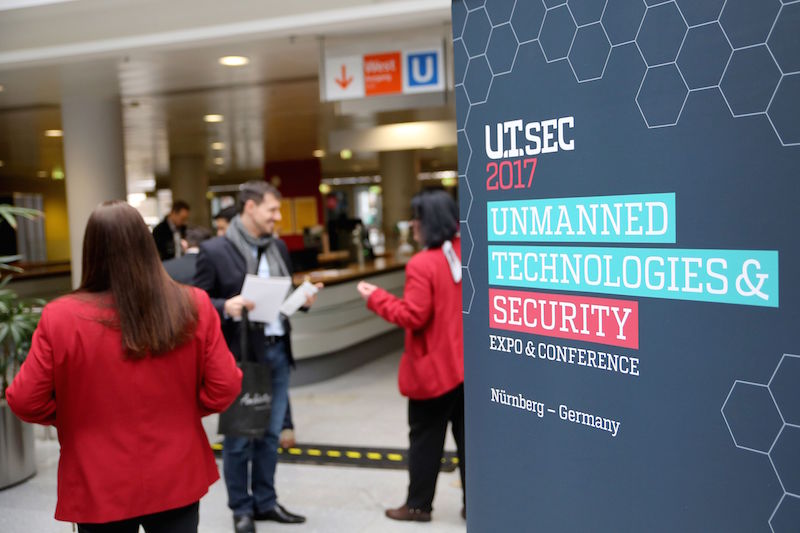
The U.T.SEC Expo is a platform for exploring drones and unmanned systems' security applications and defense. Experts discuss current trends such as swarm technology, hybrid propulsion, and intelligent sensors. The event aims to redefine security tasks and improve public perception of drones, showcasing their potential in humanitarian missions and law enforcement.

On Wednesday, March 7th, and Thursday, March 8th, 2018, the U.T.SEC – Unmanned Technologies & Security Expo & Conference will take place for the second time parallel to the special trade fair for police equipment Enforce Tac at the Nuremberg Exhibition Center. The young trade fair revolves around drones and unmanned systems, their use to enhance security, but also the defense of these technologies in security-relevant structures. The patron is the State Secretary from the Bavarian State Ministry for Economic Affairs and Media, Energy and Technology, Franz Josef Pschierer.
 The use of unmanned systems (UAS) – commonly known as "drones" – will significantly increase in all areas in the coming years, especially in the context of security. Prior to the U.T.SEC, we spoke with an expert in this field: Karsten Schudt has been the managing partner of 3W-International GmbH since 2009. The Hessian company is considered the world's leading provider of 2-stroke combustion engines for unmanned aerial systems. Through the global activities of 3W-International, Schudt has acquired extensive knowledge of international UAS applications.
SPARTANAT: Through your work, you have gained a broad overview of international developments in UAS technology. What general trends do you see?
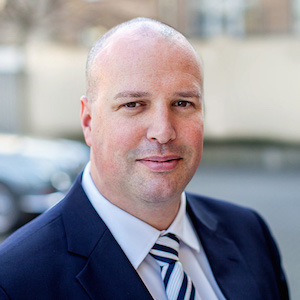 Karsten Schudt: Currently, we are in a period where the industry is undergoing significant changes. We assume that more systems are now being used for civilian applications than military ones. As a result, new requirements are being imposed on unmanned aerial systems. The use of UAS swarms, hybrid propulsion technologies, self-directed flight systems, ever more intelligent camera and sensor packages, and an increase in performance at decreasing costs are just a few of the changes currently taking place. It can be stated that UAS will fundamentally change our lives, also in security areas.
SPARTANAT: The efficient use of UAS seems to be increasingly in focus. What technical developments can we expect here?
Karsten Schudt: In the past, efforts were made to develop airborne systems. The driving force behind this was military applications. With increased use in the civilian sector, an economic, efficiency-oriented focus has been adopted. Systems that do not fly do not earn money. This efficiency mindset has now also reached the military sector. In other words, UAS must be efficient in all application areas today: the market demands ever greater ranges, higher payloads, longer flight durations, with constant or reduced energy consumption.
"Small systems with powerful cameras do not cost a fortune, so that police and private security services can make these investments."
SPARTANAT: How will these developments affect the use in the security sector?
Karsten Schudt: The costs for using UAS, no matter how they are powered, will decrease. Additionally, UAS will be used for a wider variety of applications. Reduced costs and flexibility are of course also important in the police sector. Small systems with powerful cameras do not cost a fortune, so that police and private security services can make these investments. This also applies to large systems that are equipped, for example, with combustion engines. A helicopter of this kind can be used for border protection on one hand, but also for the search of boat refugees in the Mediterranean or for surveillance of shipping traffic in the English Channel. The same goes for transport tasks. Where in the past only small amounts of medicines or blood supplies could be transported, today you can transport entire weekly rations to oil platforms far out in the North Sea, for a fraction of the traditional price.
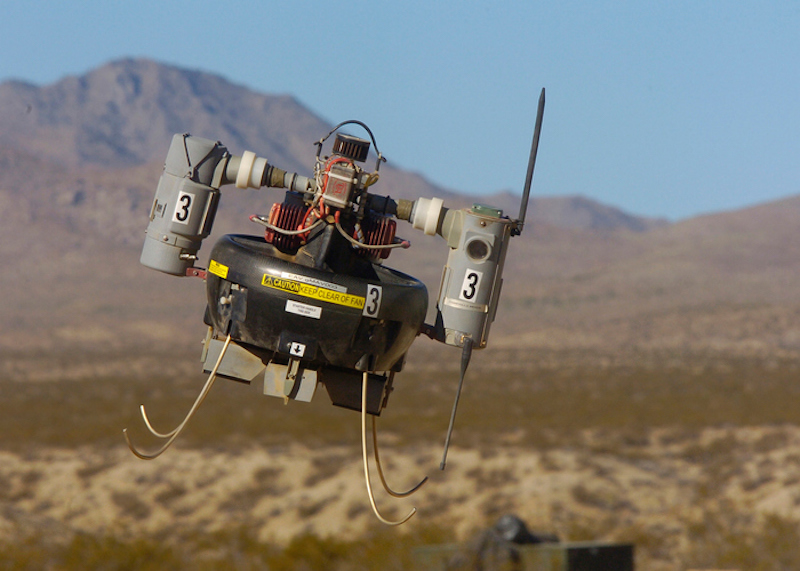
A Micro Air Vehicle in test flight. It is intended to assist EODs in use.
SPARTANAT: Do we have to assume that UAS will redefine security tasks?
Karsten Schudt: Yes. We increasingly see in the press that UAS used in leisure activities violate security-sensitive areas. More investment needs to be made in educating users. In addition, there are threats that were previously unknown, such as industrial espionage or terrorist attacks using unmanned systems. This will lead to a significant growth in drone defense. But there are also entirely new possibilities. The combination of high-resolution cameras, facial recognition software, and drones would offer entirely new possibilities in crime fighting.
"With the camera system, both aircraft are similarly capable. But in terms of cost, the unmanned system beats the helicopter."
SPARTANAT: The use of UAS is still viewed skeptically by society at large. To what extent can UAS provide significant support in humanitarian missions, for example?
Karsten Schudt: UAS are extremely flexible and quickly deployable. Speed is crucial in humanitarian missions. Let's take sea rescue, for example, and compare the use of a conventional helicopter with a hybrid VTOL (Vertical Take Off and Landing). In terms of the camera system, both aircraft are similarly capable. But in terms of cost, the unmanned system beats the helicopter. Both in acquisition, maintenance, and operation. Furthermore, flight times are only limited by fuel consumption, as pilot flight time regulations do not apply. Large areas can be automatically flown thanks to autopilot. With vertical takeoff capability, such a system can be used anywhere like a helicopter, as it does not require large infrastructure. The advantages here are clear.
SPARTANAT: What other tasks can UAS undertake to improve their image?
Karsten Schudt: In general, if tasks need to be completed quickly and cost-effectively in large areas, UAS always have an advantage. For example, in combating poaching in Africa or transporting medications to remote areas, such as Papua New Guinea or in earthquake disasters where entire infrastructures have collapsed.
SPARTANAT: As a lecturer, you are participating in U.T.SEC for the second time. How relevant is the trade fair for questions related to the use of UAS in security sectors?
Karsten Schudt: Due to the fast-paced nature of this industry, it is necessary to consistently and continually exchange information on the possibilities of use, technical developments, and risks. The premiere of U.T.SEC in 2017 showed that it provides the right framework for security-related applications involving unmanned systems. The quality of the conversations was very good. It is important to have such an event to facilitate exchange among all stakeholders.
3Winternational on the web: http://3w-international.com/
Safety fairs of the NürnbergMesse
NürnbergMesse has proven expertise in the field of security. With events like Enforce Tac – Trade Fair for Law Enforcement, it-sa and it-sa Brasil – Trade Fairs for IT Security, FeuerTRUTZ – Trade Fair for Preventive Fire Protection, Perimeter Protection – Trade Fair for Outdoor Security FIRE & SECURITY INDIA EXPO as well as U.T.SEC – Unmanned Technologies & Security, it brings together a total of around 1,200 exhibitors and approximately 30,000 visitors from all over the world. More information at:
www.nuernbergmesse.de/sicherheit
The U.T.Sec 2018 on the web: www.utsec.de

SPARTANAT is the online magazine for Military News, Tactical Life, Gear & Reviews.
Send us your news: [email protected]
Ad
similar
Get the weekly SPARTANAT newsletter.
Your bonus: the free E-Book from SPARTANAT.
