Get the weekly SPARTANAT newsletter.
Your bonus: the free E-Book from SPARTANAT.

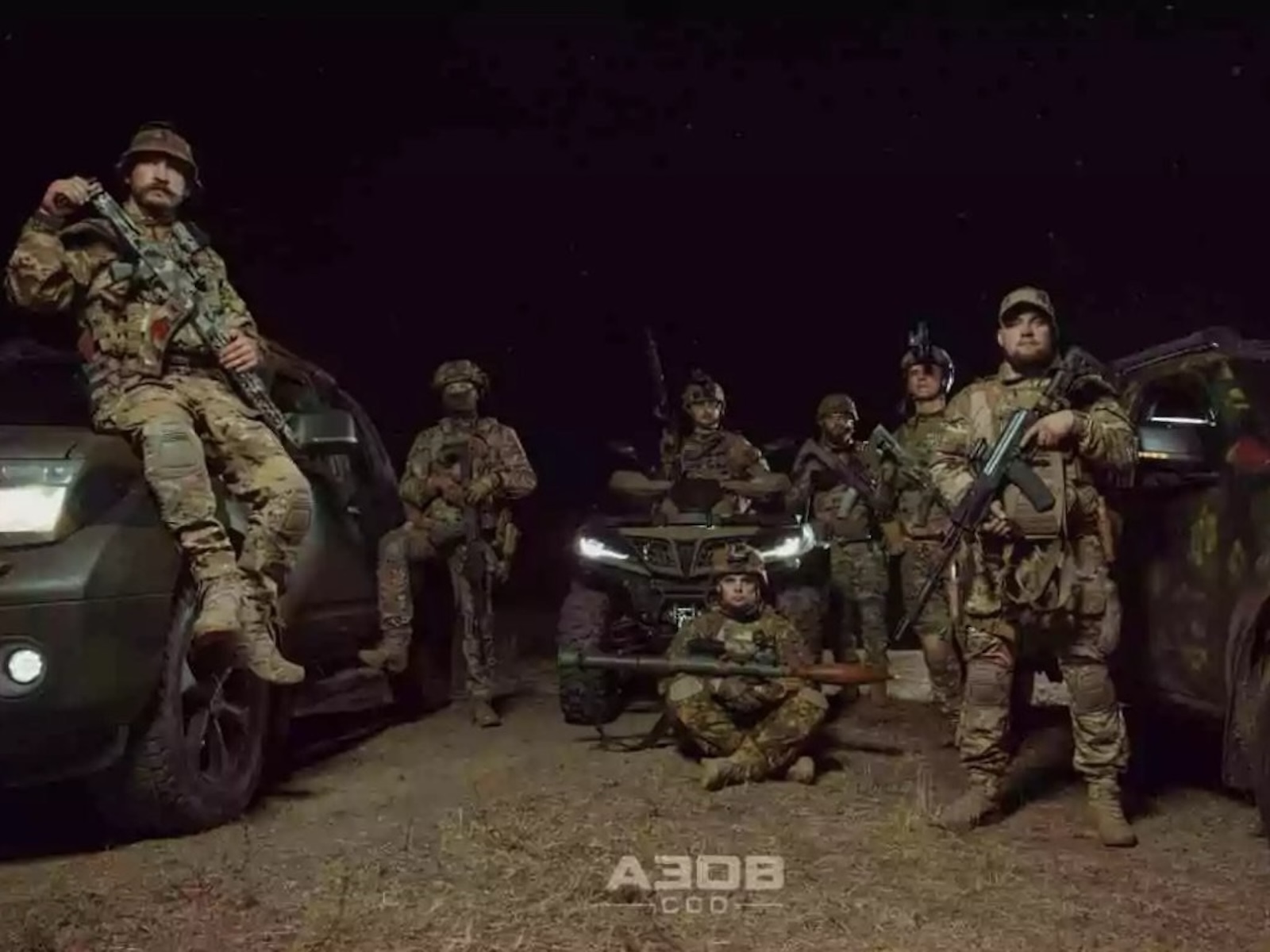
The VIVALDI Lessons
Operation Vivaldi, a strategic Ukrainian offensive in the Donetsk region, involved high-stakes drone warfare and innovative battlefield tactics. The operation prioritized causing operational pressure over traditional territorial control, utilizing small infantry groups and advanced technology to disrupt Russian defenses while minimizing casualties.

Three soldiers zigzag through the rubble of a village. A swarm of FPV drones circles overhead; a mine could be lurking beneath their boots at any moment, so they stay on the concrete roads. This goes on for four hours. All three survive. It’s a miracle. An analysis by Lars Lange.
The village is called Shandryholove and covers 0.17 square kilometers, consisting of about fifty houses, most of which have been destroyed. It took more than a month to capture it. For the entire operation—in which the village was just one location among many—Ukraine’s 3rd Army Corps reports 277 square kilometers of recaptured territory and 16 settlements, as of October 14.
The capture of the village is part of Operation Vivaldi and is taking place in the north of the Donetsk region, around Lyman. The city is a transport hub for roads and railways at the northern approaches to Sloviansk and Kramatorsk. Russian troops had been trying for months to bypass Lyman and encircle the Ukrainian defenses to the east. For twenty months, the 20th and 25th Armies worked their way toward the town.
Ukraine launched Operation Vivaldi as early as May, but Kyiv kept the operation secret until September.
The primary objective cited was to prevent a Russian encirclement of Sloviansk and Kramatorsk from the north.
2. The Preparation
Technical preparations and ground operations proceeded in parallel during Operation Vivaldi. As early as the spring, Ukrainian units advanced near Shandryholove, while at the same time the Russian defensive line was being targeted in depth.
According to their own reports, the drone units of the 3rd Army Corps flew 36,000 missions against logistics targets, reports the Ukrainian specialist portal Militarnyi. Initially, operations extended up to 50 kilometers behind the line of contact; later, up to 120 kilometers. Attacks on fuel depots, supply depots, command posts, and vehicles reportedly forced Russia to relocate its depots and extend its supply routes.
The strikes even reached deeper into enemy territory. According to Colonel Markus Reisner of the Austrian Federal Army, Ukrainian Hornet drones flew more than 150 kilometers behind Russian lines. A company commander from the Kraken Regiment told the Kyiv Independent that his unit was striking targets up to 200 kilometers away.
The well-known Russian drone unit Rubicon also came under pressure. Depots and launch sites were reportedly destroyed, and experienced teams were killed. The 3rd Army Corps eventually reported that it had neutralized Rubicon near Lyman, thereby granting Ukraine local drone superiority.
The corps was reinforced by two brigades of the Ukrainian Armed Forces specializing in unmanned systems. Electronic warfare, air defense, and interceptor drones were deployed simultaneously to suppress Russian reconnaissance and conceal the direction of the attack.
3. The Ground Phase
Following the technical preparations, the infantry advanced in small groups. There were no frontal assaults on towns. Instead, small groups of soldiers typically infiltrated along forest edges, bypassed positions, cut off supply routes, and attacked Russian forces from the rear, commanders told the Kyiv Independent. The pace varied significantly: on some days, they gained kilometers; on others, only a few hundred meters.
The small groups were intended to remain as unnoticed as possible. In some cases, two-man teams advanced several kilometers behind Russian lines. They also served as forward observers, since dense vegetation hindered even their own drone reconnaissance. Only once Russian supply lines and reconnaissance had been weakened did additional assault teams follow.
Ground robots were also deployed. Initially, they were tasked with detecting Russian reconnaissance and firing positions; later, armed systems were used against command posts and drone operators. Heavy aerial drones dropped individual ground robots behind Russian lines. Others cleared paths or laid mines. However, due to their slow speed, they were easy prey for Russian FPV teams.
Armored vehicles played only a minor role. Several isolated mechanized attacks have been publicly documented, including an attack on Serednje. The deployment of armored vehicles has now effectively become a special operation and is primarily experimental in nature: crews and infantry are trained separately, vehicles are equipped with additional gear, and numerous support measures are coordinated. Armored vehicles thus do not use a permanently open line of movement, but rather narrowly defined windows of time and space that were previously created by drones, artillery, and electronic warfare.
4. Interpretations to Date
Opinions differ on the significance of Vivaldi. Chris Tuck, a military scholar at King’s College London, sees in the operation indications of methods that could be used to restore offensive capability on the transparent battlefield.
Colonel Markus Reisner of the Austrian Armed Forces speaks of a major operational setback, but not of a breakthrough: Russia has established a new line of defense behind the Scherebez.
Elena Davlikanova of CEPA calls Vivaldi a triumph in which electronic warfare, air defense, drones, and ground robots worked together, and tanks and elements of mechanized maneuvering made a comeback.
Robert G. Rose of the Modern War Institute goes further. For him, Vivaldi paves the way for an operational breakthrough that several mechanized brigades would then need to exploit.
Dutch officer and military historian Randy Noorman disagrees with this interpretation. In War on the Rocks, he compares Vivaldi more to 1917 than to 1940: limited objectives, carefully planned effects, and incremental territorial gains rather than deep mechanized advances. Combat power increasingly stems from indirect precision fire. The enemy’s network can be suppressed locally but is quickly restored.
However, the interpretations to date can be read as a categorical mismatch: they continue to describe a new military phenomenology using the terms of the old—attack, breakthrough, maneuver, and territorial gain. In what follows, therefore, an attempt will be made to interpret Vivaldi using a different model and to examine whether the same findings can be explained more coherently with it.
5. Pressure of Effect Instead of a Shock
Classical warfare concentrates forces in space and time: fire prepares the way, followed by an advance of infantry and tanks. To achieve this, forces must be concentrated—and thus become visible on the transparent battlefield.
In the model used here, the “push” is replaced by “impact pressure”: a continuous process consisting of reconnaissance, engagement, and impact control. It is supported by the sensor-effect network, which links sensors, command, and weapons in real time. The target is not only the enemy force but also its ability to see, resupply, move, and take action itself.
The timing of Operation Vivaldi is noteworthy in itself. Tuck and Rose date the start of the operation to May. However, the offensive was not publicly announced until September 15—at a time when the 3rd Army Corps had already reported 75 square kilometers as cleared and another ten as liberated. It is therefore difficult to identify a clearly definable start to the “offensive.”
Ukrainian infantry had already been advancing in parallel since the spring, while at the same time Russian logistics, drone forces, air defense, and electronic warfare were being targeted.
Vivaldi can be interpreted as an intensification and spatial consolidation of an already ongoing process of impact. The operation thus does not mark a clear transition from non-attack to attack, but rather a defined threshold within a continuous pressure of impact.
In this interpretation, however, ground movement is not part of the pressure of action itself. Where enemy sensors and firepower were sufficiently weakened locally, temporary windows of opportunity for infantry movement emerged. Their forward movement did not generate the pressure of action—it took place within the conditions altered by that pressure.
6. Viscosity, Permeability, Adhesion
For the sensor-effect network fundamentally alters the properties of the battlefield. In the model used here, viscosity refers to how strongly this space impedes movement; permeability refers to how permeable it is to a specific object. The same terrain can still be permeable for a single soldier, yet viscous for a vehicle, and nearly impenetrable for a mechanized column.
Vivaldi clearly illustrates this disparity. Small infantry groups advanced kilometers behind Russian positions. Armored vehicles, on the other hand, were deployed only in a few, meticulously prepared, almost experimental operations. The permeability of the space thus depended on who or what was attempting to cross it and how intense the enemy’s pressure was at that moment.
Viscosity and permeability appear to be variable. If the enemy’s sensors and weapons are locally suppressed, an area that was previously nearly impassable can temporarily become more permeable for certain forces. Vivaldi’s few and experimental windows of opportunity for heavy equipment can be interpreted in this way.
This gives rise to an adhesive defense. It no longer needs to pin the attacker down along a single line. Sensors and weapons can follow the attacker through the space and continue to engage him even after he has gained ground. The defense does not pin the attacker in the space, but rather maintains its own impact on the attacker. Adhesive defense does not have to stop the attacker: it can cede space while simultaneously retaining its ability to continue affecting him within that space.
The defense thus becomes space-encompassing. The fortress is no longer formed solely by trenches, bunkers, or lines of obstacles; the space itself—equipped with sensors and effects—assumes this function. An attacker can therefore cross a line and penetrate deeply without having overcome the defense. Advancing through terrain therefore does not yet constitute a military breakthrough.
The sensor-effect network can repeatedly detect and engage targets over long distances. The space thus resembles rough terrain: movement remains possible, but it constantly causes wear and tear.
7. From Control to Contamination
Who owns a village of which little more than the foundation remains? The question itself might already stem from an outdated conception of war.
Traditional land warfare aimed at control. Terrain was captured, cleared, occupied, and then held against the enemy. Control therefore required a physical presence: soldiers had to enter the space, eliminate resistance, and physically establish possession.
The sensor-effect network enables a different form of military shaping of space: contamination. Sensors and effectors permanently subject a space to operational pressure. The enemy can enter it and even hold individual positions, but movement, resupply, and utilization are constantly compromised.
The working hypothesis is therefore that the concept of spatial control has become an unnecessary relic of the pre-drone era. For military purposes, it may suffice to permanently contaminate a space in such a way that the enemy cannot make effective use of it.
Schandryholowe makes this distinction visible. To gain complete control of the village, Ukrainian soldiers still had to enter basements and search for remaining resistance. For the military contamination of the space, however, this biological presence was not necessary. The three soldiers were needed because control and occupation remained the stated objectives.
In this interpretation, the three soldiers appear as “liquidators”: the human beings who eliminate any remaining resistance after the technical effect has taken hold and transform contamination into classical control.
This could represent a categorical mismatch, comparable to the frontal assaults of World War I against machine-gun positions. At that time, soldiers continued to be deployed en masse for attacks, even though machine guns and artillery had already made such attacks extremely costly in terms of casualties.
Today, a similar mismatch might lie in seeking to achieve control through biological exposure, even though the sensor-effect network has long been capable of contaminating a space.
Although today’s mismatch is less visibly catastrophic, it can still result in significant casualties due to biological exposure that is no longer militarily necessary. Soldiers are thus still sent forward, even though their presence does not always produce additional military effect.
A logic of contamination rather than control gives rise to a different type of infantryman: the projector. His role is not to clear the area or to occupy it through his presence, but to extend the sensor-effect network further forward. In the model, he can, for example, set up relays, operate technical systems, deploy effectors, or enable other functions that would not be available without his advanced presence. Its value lies not in occupying the area, but in opening up additional operational space and thereby extending the contamination.
Herein lies a potential paradigm shift: away from controlling the area, toward its permanent contamination. A biological presence then becomes militarily necessary only where it generates additional projection capability. Gaining terrain is not a military gain as long as it does not generate projection capability.
Projective power here refers to the ability to monitor a space through sensors and means of action and to contaminate it for the enemy—regardless of whether one’s own soldiers occupy it.
Control rather than contamination could later become the dominant principle again—if a new physical entity of ground warfare emerges that can assert itself in the contaminated space and physically organize it. This new superform of land warfare is so far recognizable only in its embryonic stages. Until then, there is much to suggest that the current war should be interpreted less as a struggle for permanent control of space than as a competition to generate and sustain pressure to act.
Interpreting Vivaldi as a classical offensive could therefore fail to capture its novelty: The concept of an attack presupposes a definable event, whereas pressure of effect describes an ongoing process in which reconnaissance, impact, movement, and occupation increasingly merge into one another.
For training, equipment, and leadership, this would mean conceiving of infantry less as bearers of their own firepower and more as operators and extensions of the sensor-effect network. The situational picture, too, would then have to show not so much lines and occupied areas as a gradient of effect: the spatial distribution and intensity of the pressure of effect.
In this interpretation, the three soldiers from Schandryholowe would not be the bearers of an attack, but rather a dispensable extravagance: people who expose their bodies for four hours to biologically occupy a space whose military contamination had already been mechanically established beforehand.
LARS LANGE works as a freelance journalist covering foreign policy, international conflicts, and military-technical developments, and publishes regularly in Telepolis and junge welt. He studied philosophy and writes primarily about modern warfare, drone technology, air defense, maritime security, and the political consequences of new military technologies.
Operation Vivaldi: the closing press conference with a summary from the Ukrainian side,

SPARTANAT is the online magazine for Military News, Tactical Life, Gear & Reviews.
Send us your news: [email protected]
Ad
similar
Get the weekly SPARTANAT newsletter.
Your bonus: the free E-Book from SPARTANAT.
