Get the weekly SPARTANAT newsletter.
Your bonus: the free E-Book from SPARTANAT.

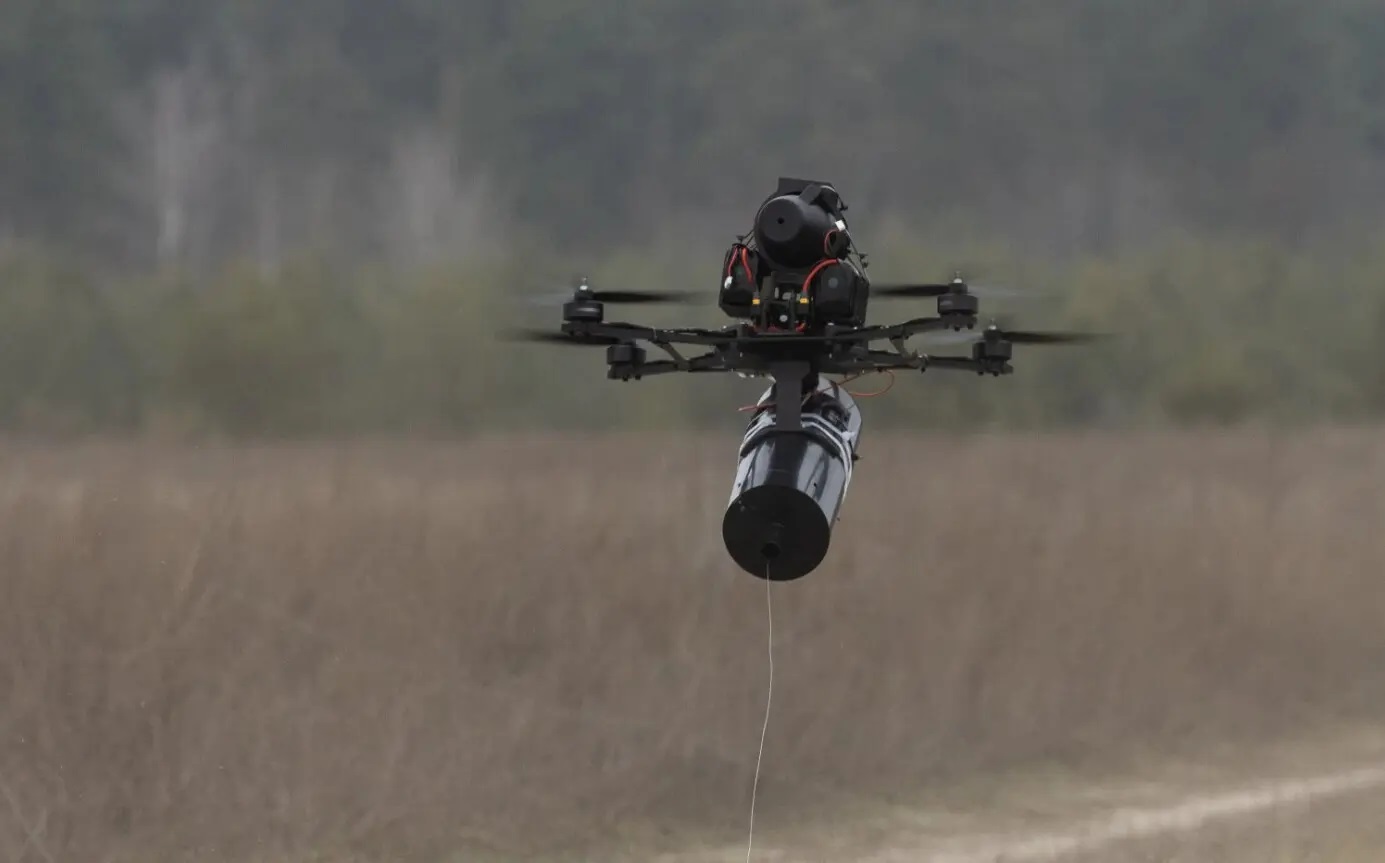
Characterizing the FPV Fragment Threat
This article analyzes the distinct threats posed by FPV drones compared to traditional artillery, emphasizing the inadequacy of current soft armor against high-velocity drone fragments. It stresses the need for improved armor designs, testing protocols, and data collection to enhance soldier protection in modern warfare.

Our friend Jake Ganor has written a very interesting article for Body Armor News and we want to share this wisdom with you: I’ve written a few words on the fragment threat, though it was oriented towards conventional artillery and mortars. To very briefly summarize: No soldier can withstand being in close proximity to a detonating artillery shell, as the blast wave is powerful enough to immediately kill or incapacitate. When fragments are the problem, it’s further out, and those fragments have usually already traveled some tens of yards. Because shell fragments decelerate rapidly in air, they are generally quite slow upon arrival; the statistically average casualty-causing shell fragment is ~15 grains and moving at ~1000 feet per second, and a soldier in frag-casualty range from a detonating shell might be struck by one or two such fragments.
The drone, the FPV drone in particular, is altogether different. This is a fact that armor designers and military procurement have yet to appreciate.
There is no generic “FPV warhead”; there is a menu of adapted ordnance carried by an aimed platform. There are three primary differences between the drone threat and the artillery threat:
- Drone-carried warheads are small — under 6.5 pounds all-in, so the fatal blast radius is minuscule.
- The platform aims, so detonations occur on contact, within yards of the target, or as deliberate command-detonated airbursts.
- The platform chooses the geometry: Ground and parapet bursts drive fragments upward into the pelvis, groin, thighs and arms; airbursts drive them downward into the skull, neck, yoke and shoulders.
With artillery, we could determine what the statistically average fragment looks like. With drones, we can’t, as there are three distinct buckets. There’s a light, very fast bucket: Roughly 2-8 grains, launched at 4265 to 5900 feet per second by sleeved RPG warheads and other compact preformed elements. There’s a light, slower bucket: also roughly 2-8 grains, but thrown by the natural fragmentation of VOG-class grenade rounds at approximately 2950 feet per second. And there’s a medium-heavy bucket: Roughly 10-32 grains from dedicated fragmentation rounds (VMZ’s OG-7V specification lists at least 850 fragments averaging ~14 gr; its OFG-7V, 360 semiready fragments at 32gr), grenade fragments, and much of the dropped mortar spectrum. These typically launch at 2500-4300 feet per second and, in the near-miss geometries soft armor can do anything about, impact at roughly 1650-2800 fps, about 2350 fps on average. A heavy tail above ~50 grains is far less prominent than in 122-155 mm artillery, and doesn’t need to be considered here.
What body armor can and cannot address
Standoff - the distance from munition detonation - is the key variable, and there is woefully insufficient public data: No credible published distribution of body-to-burst distance exists. Let’s assume casualty-producing detonations spread log-uniformly over roughly 2-44 yards; in this case, about 85-98.6% of fragments hitting a person arrive above the modern soft-armor envelope!
Let’s put this another way: Standard-issue soft armor won’t stop half of those fragments, and in some cases won’t stop much more than 1% of them!
Soft armor was built to stop shell fragments at 1600 feet per second, and the current-issue US military soft armor package has a 17-grain FSP (Fragment-Simulating Projectile) V50 of roughly 1800 feet per second - which, with a number of caveats that are not worth getting into here, can be taken to mean that half of all 17-grain fragments are likely to penetrate at 1800 fps, most are likely to penetrate at 1900 fps, and virtually all 17-grain fragments will penetrate at 2100 fps. This sort of soft armor package is, emphatically, no barrier to fragments moving at 4200 feet per second, whatever their grain weight.
If we take as axiomatic the notion that wearable armor should be optimized for protection from likely threats, then the corollary is that the design problem is the near-miss, not the direct hit. Armor must be built around the largest population of fragments it can realistically intercept: The soldier who is close enough to the burst to be struck, perhaps several times, but far enough from it that arriving fragments are stoppable, even in principle, by wearable armor. The 5000 fps direct-attack fragment is a counter-UAS problem; the near-miss fragment is the soft armor problem.
Four further points complete the threat picture:
- The impact distribution: The model’s absolute median fragment is approximately 6.8 grains at 4200 fps. The “average range” is 5.9 to 14.1 grains at 3700 to 4280 fps. This includes contact-detonations and rocket-warhead events that body armor cannot realistically mitigate. In the lower-velocity portion – the near-miss armor-addressable fragment population – the model’s median fragment is roughly 4-6 grains at ~2300 fps; half the mass and more than twice the velocity of the artillery average quoted above. That median is the light-and-slow bucket showing itself: A 4-grain VOG-class fragment leaving at 2950 fps arrives at about 2290 fps some twenty feet out, which is squarely inside the standoff band that dominates the hit-weighted distribution.
- The count: Where a soldier in artillery-fragment range might be struck by one or two fragments, an FPV near-miss presents a cloud — anywhere from half-a-dozen to six dozen near-simultaneous fragments across a body-sized area. Single-shot test protocols understate that problem, which is why cluster testing appears in the recommendations below.
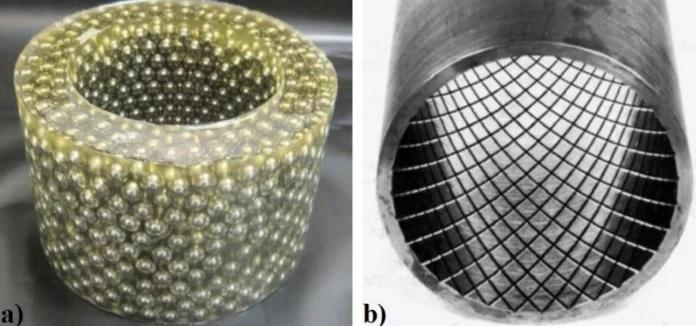
- Improved regularity: Compact spheres and cylinders retain velocity better than tumbling irregular fragments of equal mass — in our model’s selected geometries, half-velocity distances of roughly 85 feet against 55 - so the dangerous envelope of sleeved warheads extends further out than natural-fragment intuition suggests. They are also more repeatable in mass, geometry and hardness, which makes them both more predictable and more important to test directly.
- Material heterogeneity: The standard “fragment simulating projectile” used in armor tests is hardened to ~30 HRC, which makes it marginally harder than a natural shell fragment but generally much softer than a steel preformed fragment, which in many cases is a 60-66 HRC tool steel ball bearing. It is also considerably less dense than tungsten alloy — and although an equal-mass tungsten fragment is not harder to stop than a 30 HRC steel FSP, tungsten fragments retain their velocity far better than steel, so tests vs. tungsten need to be velocity-adjusted and biased towards considerably faster impacts. Tungsten is relatively rare in an FPV warhead economy that runs on cheap steel, but it’s still a live threat.
Blast changes the medical picture, not the V50 target. Remember that drone-carried warheads are small. In the open, fragments set their lethal envelope. This is because blast from tiny charges dies out far faster than the fragments do. A grenade-class fill produces a millisecond overpressure pulse, and lethality from such pulses is surprisingly limited: Free-field lethal blast is measured in inches to a few feet, and even the largest FPV-carried fills — about 1.5 pounds of explosive — push lethal overpressure only to roughly 6 feet in the open. The same warhead throws fragments at 2500-6000 fps that remain dangerous for dozens of yards. The fragment cloud outranges the blast wave by an order of magnitude — which is why grenades are fragmenting weapons rather than blast weapons.
The new soft-armor V50 floor
Here the answer is clear: 2130 feet per second against the 17-grain FSP. The number comes from a step rather than from an average. Because V50 rises as fragment mass falls - roughly as the inverse fourth root - a system rated 2130 fps against the 17-grain FSP is running near 3060 fps against a 4-grain fragment, and that is above the roughly 2950 fps launch velocity of VOG-class natural fragmentation. Clearing a munition’s launch velocity is worth far more than clearing its average arrival velocity, because it takes that munition’s entire fragment output at every standoff, including contact. So 2130 fps removes the light-and-slow bucket from the problem outright. It does not touch the rocket-warhead derivatives - sleeved preformed elements at as much as 5900 fps and the OG-7V class at 4300 fps stay above any textile V50 at any practical weight.
The weight cost for a 2130 fps V50 is remarkably modest. V50 scales with the square root of areal density, so moving from the current 1800 fps package at roughly 0.85 psf to 2130 fps lands near 1.2 psf - about two to three pounds across a full soft-armor envelope. Three pounds to delete an entire munition class from the threat picture is a good trade.
2060 feet per second should be the absolute minimum for the principal flexible fragmentation layer. This is by no means arbitrary: Below about 2060 fps the 4-grain equivalent drops under the VOG-class launch velocity and the bucket reopens. Soft armor systems with V50s under 2060 feet per second are anchored to artillery-era assumptions and miss too much of the lighter-and-faster spectrum.
Coverage must be considered. In the Ukraine Part III burden model, marginal casualty reduction per pound ran ~0.057 for torso soft armor, 0.039 for a yoke, 0.035 for pelvis and 0.031 for deltoids - against ~0.020–0.023 for raising V50 on already-covered areas, and only ~0.014 for thighs. So: Buy torso coverage first, then yoke and neck, then pelvis and junctional region, then deltoids - and bring those regions to the 2130 fps class before adding broad thigh coverage. Then grade by anatomy:
| Region | Target V50 (17 gr FSP) |
| Neck and upper yoke | ~2200-2300 fps |
| Torso soft armor (off-plate) | ~2060-2130 fps |
| Pelvis and proximal medial thigh | ~2060-2130 fps |
| Deltoids and upper arms | ~2060-2130 fps |
| Distal thigh and lower limb | ~2060 fps, or omit |
| Helmet | 2200-2300 fps+ class |
Components rated 1300-2060 fps are secondary protection. They might be useful, and they’re the historical baseline, but they’re underpowered in our modern FPV era.
Testing to the threat
First of all, we must keep the 17-grain FSP — at 17 grains it anchors the medium branch against the OG-7V’s ~14-grain average fragment, and it carries decades of extremely useful test data. But then there’s a lot of work to be done in building around it:
- Emphasize light bins. 2-grain projectiles at 2600-4000 fps and 4-grain at 2130-3800 fps; 17-grain and 31-grain at 1650-2650 fps. It makes very good sense to replace the 64-grain with a more representative 31-grain or 40-grain.
- Test geometry, not just mass. Chisel-nosed FSPs, RCCs, steel spheres, short cylinders, cubes. Spheres slip and wedge between yarns differently, and woven and laminate systems can rank differently against spheres than against FSPs. If the threat is increasingly preformed, test preformed geometries — spheres and cubes.
- Don’t test only at 0°. Rising ~10-45° for ground and parapet bursts, descending ~30-60° for airbursts. Do not assume a universal obliquity correction factor. It is sometimes the case that fast-moving steel penetrates textile and composite armor more readily at 30° than at the so-called worst-case 0° — this is, actually, known to be the case with the 7.62x39mm MSC vs. UHMWPE plates and helmets. (See, e.g., the PASS paper “V50 Study of Light-Weight Body Armour Inserts Under Angle Shot” by Bolz et al. at Rheinmetall.)
- The cloud. Cluster shots at ~1, 2 and 4 inches spacing, including edges, seams, overlaps and previously damaged material, near-simultaneous where practical. Report the shift in the penetration-probability curve and residual velocities; do not assume a fixed degradation for any architecture.
- Test against tungsten and hardened steel. As mentioned above, FSPs are generally hardened to about 30 HRC. This is harder than fragments from casings, it’s roughly equivalent to tungsten alloys though with ~2.5x lower density, and it’s far softer than the hardened steel preformed elements that are sometimes used in fragmentation sleeves, which generally exceed 55 HRC and sometimes even 65 HRC. Again, one can’t assume a universal correction, and armor really ought to be tested against all types of threat material. It could be that a system that performs adequately against FSPs fails quite miserably against hardened steel balls. If this is the case, it’s better to find out in the lab, rather than on the field. (Needless to say, such a finding would also imply that your side might want to employ fragmenting munitions with hardened steel sleeves, to more easily slice through the other side’s armor!)
Instrument the war - and what would change the conclusion
Our model, like all similar models, relies on assumptions. Most, such as fragment type and the velocity-distance curve, are sufficiently well-founded. But the average standoff distance from detonation is particularly important, and here much more hard data is required. It is so vital to the armoring effort that I believe that it should be measured and reported by military medical and intelligence teams as a priority.
Fragments ought to be recovered from wounds, armor, clothing, vehicle skins and terrain; mass, geometry, material, strike angle, anatomical region and engagement context ought to be recorded, with standoff in coarse categories — contact, under 6 feet, 6-15 feet, 15-30 feet, over 30 feet. Surgical recovery alone is biased toward survivors and retained fragments; combine it with armor and scene exploitation and instrumented arena tests of representative warheads. That dataset would translate directly to better armor, and to lives saved.
The 2130 fps V50 objective is, I think, fairly robust. But consider what would move it: If casualty-producing standoffs are overwhelmingly very short, with most hits within 10 feet, then textile-based armor really has no answer to the drone threat, and efforts should shift to concealment, other counter-drone methods, and improving mobility. And if it turns out that 31-grain fragmentation munitions dominate employment at any standoff from 5-80 feet, an explicit 31-grain requirement would become essential, tested at that class’s own lower arrival velocities rather than at 17-grain velocities. And if the modal preformed element turns out to be a hardened ball at 60 HRC or above, then 2130 fps as measured with a 30 HRC FSP corresponds to materially less real protection than it appears to, and the whole target has to move upward.
Artillery shell fragments and FPV-era fragments are remarkably distinct. Armor built for the one isn’t necessarily the right answer for the other. The drone-delivered fragment is lighter, much faster, much closer, and it arrives in a denser and more lethal cloud. Test programs, procurement, design, and development all need to start catching up.
SPARTANAT is the online magazine for Military News, Tactical Life, Gear & Reviews.
Send us your news: [email protected]
Ad
similar
Get the weekly SPARTANAT newsletter.
Your bonus: the free E-Book from SPARTANAT.
