Get the weekly SPARTANAT newsletter.
Your bonus: the free E-Book from SPARTANAT.


The precision of the flying lifesavers
The Christoph 100 rescue helicopter crew, comprising personnel from the German Air Rescue Service, Berlin Fire Department, and Bundeswehr Hospital, undergoes annual winch training to master emergency evacuations from urban terrain. This intensive training enhances collaboration and ensures readiness for time-critical medical emergencies in Berlin.

When every second counts, the use of a rescue helicopter with a winch is a decisive advantage in time-critical emergencies. Specialized training shows the crew how to rescue people from urban terrain using the winch during flight operations when landing at the scene is impossible.
The crew of the Christoph 100 rescue helicopter (RTH) – staffed jointly by the German Air Rescue Service (DRF), the Berlin Fire Department, and the Bundeswehr Hospital (BwKrhs) in Berlin – trains once a year in what is known as winch training during flight operations.
“Extremely demanding for the entire crew”
A delicate touch and a keen eye were required at the Lehnin military training area. This is where the helicopter crew trained in the targeted deployment and retrieval of rescue teams in urban terrain in a very small area. For example, the pilot lands on a sloping surface with only one skid and the rescue duo is deployed.
“This is extremely challenging for the winch operator, who is also the pilot, but also for the rescuers getting out, because the rotor comes very close to them,” explains Senior Medical Officer Lutz Siegl. The experienced emergency physician is part of the helicopter crew and head of the Center for Emergency and Rescue Medicine at the BwKrhs Berlin.
Realistic team training
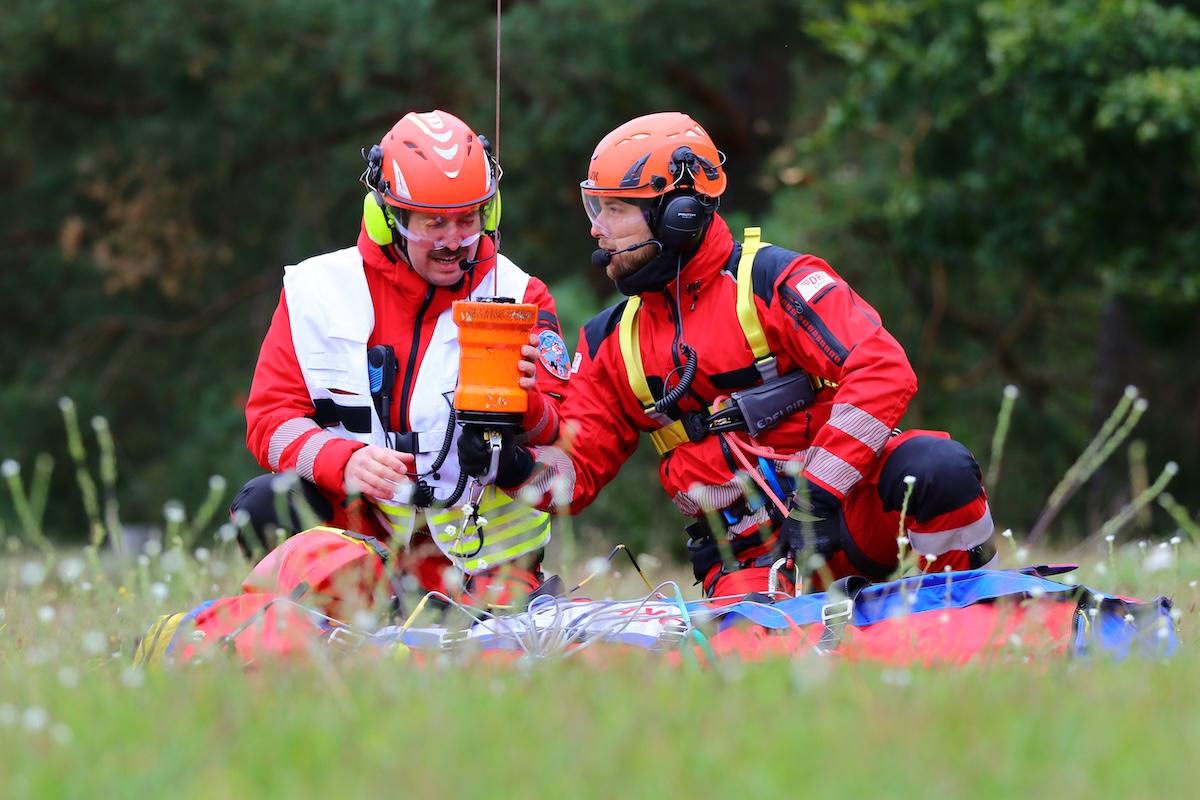
After a safety briefing on the helicopter and the winches on the ground, the participants repeat hand signals and commands, review how to behave when the cabin door is open, and discuss the course of the exercise. After the teams have been assigned, realistic training takes place at three stations in the field with several winch runs per team.
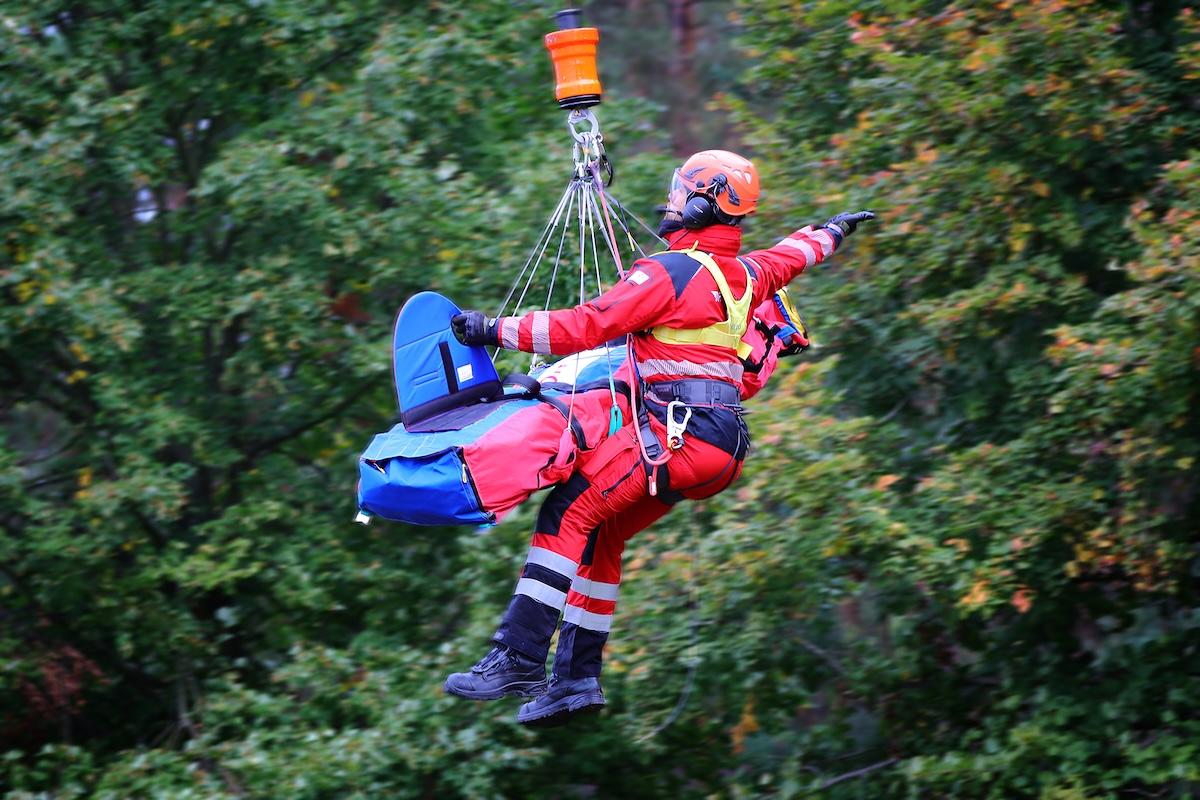
Abseiling from a height of 50 meters
To ensure the necessary confidence in handling the rope winch, this training is mandatory for every crew member once a year. Over two days, doctors and paramedics from the BwKrhs practice alternating scenarios – sometimes with a “rescue bag,” sometimes with a rescue sheet.
“The pilot only sees us as a small dot swinging back and forth on a 50-meter-long rope. This is particularly dangerous in windy conditions, because the helicopter shifts, and so does the rope, and he still has to drop us off,” says Siegl, describing the training of the crew members of the DRF helicopter RTH 2706 Christoph 100.
Mixed teams
Regular winch training on the DRF helicopter, which is stationed at the Helios Clinic in Berlin-Buch, ensures high-quality training and further education for all flying personnel. As one of three helicopters in Berlin, the Christoph 100 is primarily called out to medical emergencies. The flying crew is made up of a mix of medical personnel from the German Armed Forces and the fire department – the pilots are provided by the DRF. For this reason, it is essential to practice rescue operations under realistic conditions.
“It's part of our everyday routine for our paramedics to fly with fire department doctors and for us Bundeswehr doctors to fly with fire department paramedics,” reports the 48-year-old emergency doctor, adding that the team spirit in an air rescue team is different and that the camaraderie is special.
The next joint training session for the flying lifesavers is scheduled to take place in the spring of next year. With their motivated dedication and courageous commitment, the rescue team members – whether on the ground or in the air – are doing great things for the residents of Berlin and its surrounding area.
SPARTANAT is the online magazine for Military News, Tactical Life, Gear & Reviews.
Send us your news: [email protected]
Ad
similar
Get the weekly SPARTANAT newsletter.
Your bonus: the free E-Book from SPARTANAT.
